Movie night feels different when the lights are right. Colors look richer, the Screen feels bigger, and your eyes can actually relax. And if you live along the Wasatch Front, you know the swing from bright Utah afternoons to long winter nights can be dramatic. That’s why the way you handle light at home—how bright, where from, what color—can make or break your theater. Here’s the thing: great Lighting is less about fancy fixtures and more about intentional layers that work together. You know what? It’s not hard once you see the big picture.
Why lighting matters more than you think
We tend to think projectors, screens, and big sound. Lighting sits in the background—until it doesn’t. Too much light washes out the image. Too little light makes the room uneasy and your eyes work harder than they should. True balance gives you contrast and comfort. It makes your screen pop without glare. It keeps faces visible without shining in your eyes.
There’s also mood. Home theater lighting sets a tone before the first line of dialogue. A soft glow around the room tells your brain, “Sit back, this is special.” And yes, that seeing-your-popcorn-while-not-ruining-the-picture trick? That’s lighting design, not luck.
Start with three layers that play nice
Ambient, task, and accent—simple, but powerful
Good theaters mix three layers. Each does a job. Together, they feel seamless:
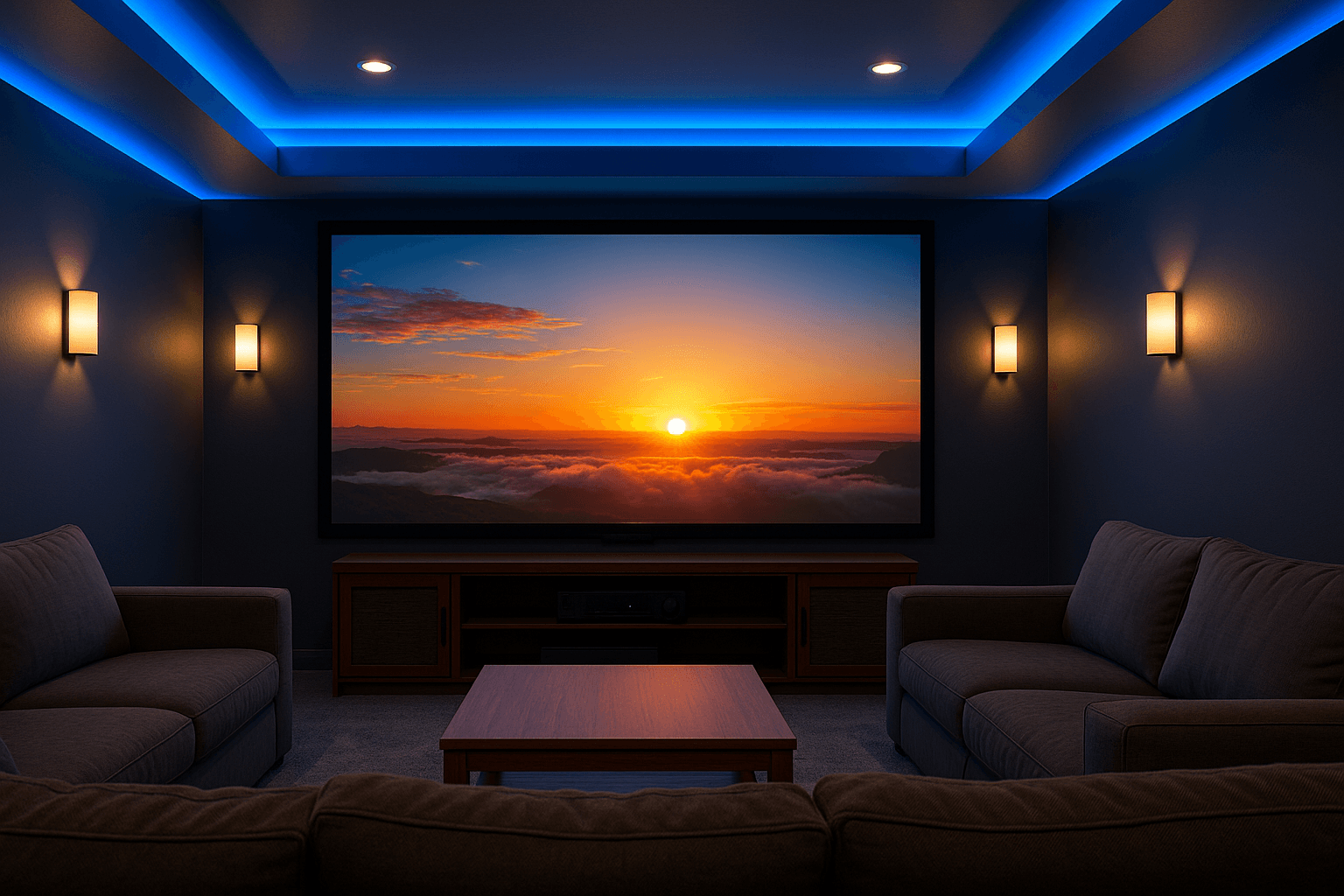
- Ambient light gives gentle, room-wide brightness. Think dimmable recessed lights or soft cove light you can run at 10 to 30 percent during previews.
- Task light handles specific needs—step lights on risers, a tiny reading spot by the back row, or a bar light that won’t spill onto the screen.
- Accent light sets the mood: wall sconces, LED strip light in niches, even a star ceiling if you’re going full cinema vibe.
It sounds like a lot, but here’s the secret: they’re all on dimmers and scenes. One tap, the room shifts. Simple.
Bias lighting: the small strip that saves your eyes
Bias lighting is a soft, even glow behind your TV or screen wall. It reduces eye strain and makes perceived contrast jump. Why? Your eyes like a middle ground between bright pixels and a dark room. A neutral backlight gives that middle ground.
For flat-panel TVs, use a high-quality LED strip behind the panel, set to a neutral white. Look for 6500K “D65.” That’s the standard for accurate white balance, the same target used in studios. For projectors with acoustically transparent screens and a dark front wall, you can backlight the wall around the screen frame rather than the screen itself.
A quick tip: choose LEDs with a high CRI (90+). That keeps colors true and avoids weird tints. And while HDR content like Dolby Vision can be dazzling, that gentle halo lets your eyes relax so the brilliance feels smooth, not harsh.
Ceilings, walls, and where light should never point
Harsh overhead light kills contrast. But you still need coverage for cleaning, setup, or board game nights. We like recessed cans on multiple zones with soft trims and warm white bulbs (2700–3000K). Aim them away from the screen. If you can, use deep-baffle trims; they hide glare. You’ll be surprised how much better the picture looks when light isn’t bouncing toward the image.
Wall sconces can be beautiful, but pick ones with downlight or up-down beams that don’t hit the screen. Same for cove lighting—place it so the glow washes the ceiling, not your projection surface.
Paint matters too. Semi-gloss looks clean, but it reflects like a mirror in a theater. Use matte or eggshell—especially on the front wall. Many Salt Lake City homes tuck theaters into basements. That’s great for light control. Just keep those bright-white ceilings in check. Darker, flatter finishes help the room disappear so the picture takes center stage.
Smart control that doesn’t get in the way
Lighting control is where the room comes alive. One “Movie” scene for pre-show. One lower level for the feature. One bright “Clean Up.” If you want no-fuss reliability, consider systems like Lutron RA3 or RadioRA 2, or go full integration with Control4 or Crestron. These bring smooth dimming, quiet fades, and easy remote or touch panel control. They also play nice with voice assistants for those “Hey, start the movie” moments.
Here’s a mild contradiction: you don’t need full automation. A simple dimmer works. But once you’ve tried scenes that ramp down as the previews start, you won’t want to go back. We often set a “Sunset” trigger, so your lighting shifts with Utah’s long summer evenings and early winter twilights.
Smart bulbs vs hardwired dimmers
Smart bulbs sound convenient, and they can be. But for theaters, hardwired control tends to be smoother and quieter—especially at low levels where cheaper LEDs can flicker. If you’re weighing choices, this quick table helps.
| Approach | Strengths | Watch-outs |
|---|---|---|
| Hardwired dimmers (Lutron/Control4) | Stable fades; wall control; no Wi‑Fi lag | Plan wiring; match dimmer type to LED |
| Smart bulbs (Hue, Nanoleaf) | Color scenes; easy retrofit | Possible flicker; network hiccups; limited dim curve |
| Hybrid (strips + dimmers) | Best of both; flexible accents | More setup; pick quality drivers |
One more thing: pair LEDs with the right dimmer type. ELV or 0–10V dimming often gives smoother low-level control than basic TRIAC dimmers. We’ll help you match them so you’re not chasing flicker gremlins later.
Small but mighty: strips, steps, and under-seat glow
Those subtle details make a room feel finished. LED strip lights tucked under a bar lip, along crown molding, or behind speaker columns add glow without glare. Step lights on risers keep everyone safe when the credits roll. Aim the light downward and forward, not toward the screen. You’ll get the safety without reflections.
Color matters. For general theater lighting, keep it warm (2700–3000K). It’s easier on the eyes, and it flatters skin tones. Save color-changing scenes for fun accent moments or sports nights. Again, bias lighting is the exception: stick with a neutral D65 look.
Daylight control in Salt Lake City homes
We love those big mountain views, but windows near a theater can flood the room—especially on bright, dry summer days. The fix: blackout shades with side channels to block edge glow. Motorized shades from Lutron Serena or Hunter Douglas give you quiet movement and reliable control. They can tie into your system so one button lowers shades and sets the lights.
Light leaks hide in small places. Door undercuts, soffit gaps, even HVAC vents can glow. We use light traps, weatherstripping, and a little layout strategy to keep stray light off the screen. It’s not fussy; it’s just thoughtful. And in winter, when the days are short and movie marathons get real, it’s easy to keep the room cozy and consistent.
Calibrate the vibe: scenes for cinema, sports, and games
Not every night is Oscar night. Most families want different looks—they’re easy to set up:
- Cinema: 10–20 percent sconces, cove at 5–10 percent, bias light on, steps at a safe low level.
- Sports: 30–40 percent ambient, bar lights brighter, accent color wash in your team’s tone. Jazz game, anyone?
- Gaming: low front light, a bit brighter in back, minimal glare on the display, bias light steady.
- Intermission: lights ramp to 50 percent over 8–10 seconds. No one’s blinded. Popcorn refills happen.
We like slow fade-ins and fade-outs—around five to ten seconds. It feels cinematic, and it’s easier on your eyes.
Budget, timeline, and what’s realistic
Here’s good news: you don’t need new construction to get great lighting. Retrofits can look clean with the right gear. We’ll assess what you have—wiring, fixture types, ceiling access—and build a plan that fits the room and the budget. In new builds, we mark can light positions, run low-voltage for LED strips and step lights, and prewire shades so everything is tidy behind the walls.
Where do costs shift? Fixture quality, dimmer type, and control system. A handful of well-placed lights beat a dozen cheap ones in the wrong spots. And a smooth dimming curve is worth it—you feel it every time the lights go down.
Common mistakes we fix in Salt Lake City theaters
- Downlights aimed at the screen: instant washout. Angle them away or switch trims.
- Shiny paint: reflections everywhere. Matte wins in theaters.
- Cold, blue LEDs: looks bright but feels harsh. Go warmer for the room; keep bias neutral.
- No dimming: on/off only is jarring. Add dimmers or scenes for comfort.
- Exposed bulbs in sconces: pretty in photos, rough in practice. Use diffusers or shades.
- Too many colors: constant RGB shifts distract. Keep accent color intentional.
Honestly, even small tweaks change the experience. Redirect a few fixtures, add bias light, set three scenes—you’re suddenly watching, not squinting.
A local touch, a better movie night
AZP Home Theaters & Automation designs and installs home theater lighting in Salt Lake City and nearby neighborhoods—from Sugar House bungalows and Millcreek basements to Daybreak family rooms and Park City retreats. We fine-tune the tech so it feels effortless. Warm, even light. Crisp pictures. Quiet fades. That “just right” glow you notice the second the room settles.
If you’re ready to brighten movie night without washing out the screen, we’re here to help. Call 385-475-3549 or 385-475-3549. Or tap to Request a Free Quote and we’ll reach out with ideas that fit your space, timeline, and budget. The next great movie night is closer than you think.