You press play, the lights dim, and the picture looks stunning—yet the room sounds a little messy. Dialogue slips under the music. Bass booms in one corner and disappears in another. If that rings true, you’re not alone. Many Salt Lake City homeowners have gorgeous theaters—often in the basement—where the room itself needs a bit of love. The good news? With a few smart Acoustic treatments for home theater, your space can sound clear, punchy, and smooth. Let me explain how.
Why acoustics matter more than another big amp
We love gear as much as anyone. But here’s the thing: the room shapes the sound more than most upgrades. Hard walls reflect sound. Concrete foundations boost bass in strange ways. Even seats and posters change how the system behaves.
You know what? More wattage won’t fix echoes. Less chaos in the room will. That means controlling reflections, balancing bass, and keeping noise low. Treat the room, and suddenly the same speakers feel more expensive. Dialogue snaps into focus. Music swells without blur. The action hits hard, then stops clean. That’s what a real home theater experience should feel like.
The room itself: size, shape, and surfaces set the tone
Salt Lake City homes vary a lot. A cozy Sugar House bungalow isn’t the same as a newer Daybreak family room. Basements in Millcreek or Holladay often have long walls, low ceilings, and concrete. Great for space; tricky for sound.
Soft finishes help. A thick area rug, lined drapes on big windows, and upholstered seats cut harsh reflections. But it’s not only about soft stuff. It’s about smart placement. First reflection points on the side walls and ceiling are key. Those first bounces are the ones that smear clarity. Address them, and everything tightens up—fast.
Bass control comes first: traps that do the heavy lifting
Low frequencies cause the biggest headaches. They build in corners. They vanish at the couch. And concrete makes them stubborn. That’s why bass traps are job one for most rooms.
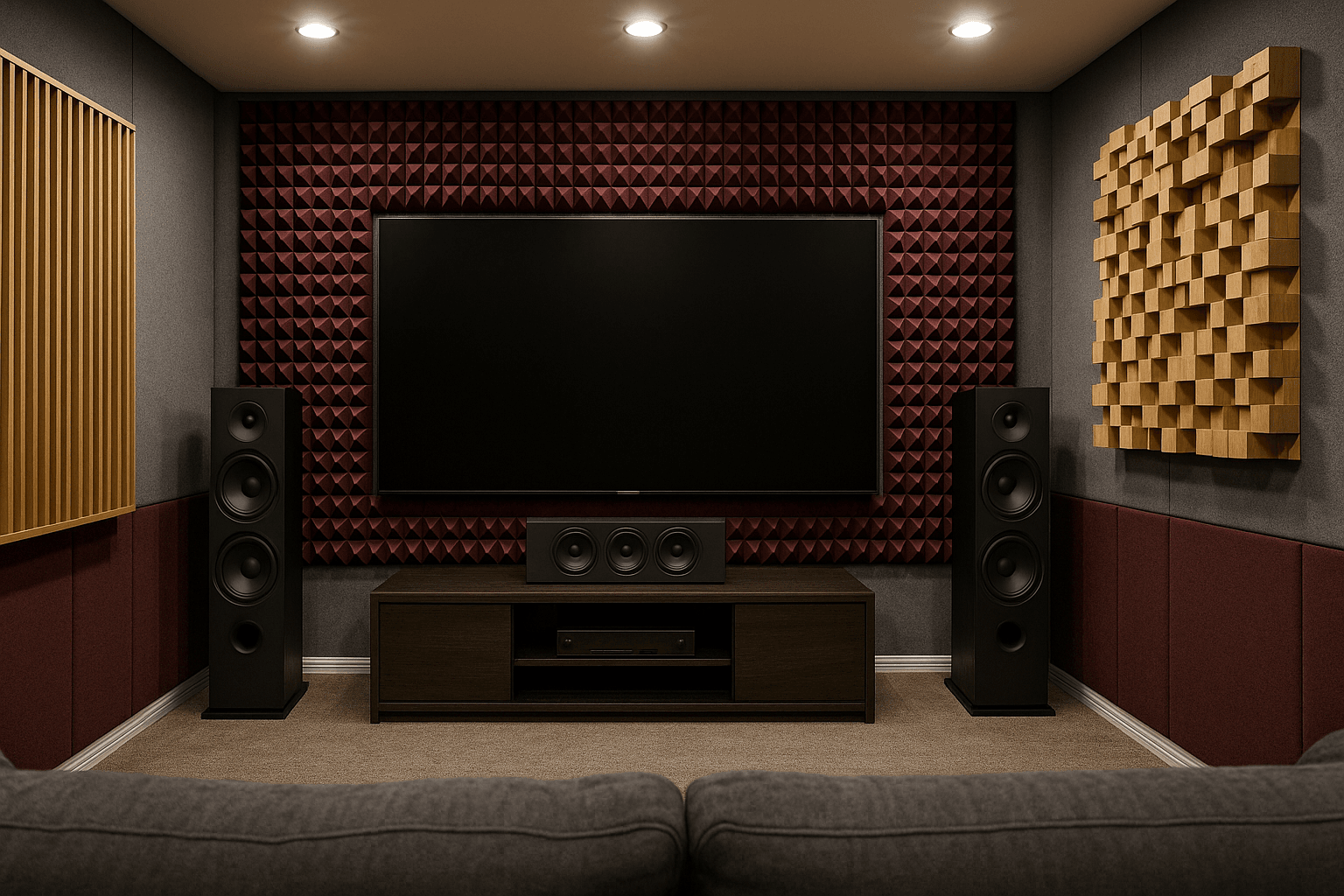
Thick traps—think 4 to 6 inches—work far better than thin foam. Corner traps catch energy where it piles up. In tough rooms, we stack “superchunk” traps floor to ceiling. Brands like GIK Acoustics, Primacoustic, and Acoustic Geometry make solid, good-looking options that pass the family test.
– Treat the corners. Two front corners at a minimum; four if you can.
– Go thicker. A 6-inch panel with air gap outperforms a 1-inch panel by miles.
– Test placement. Use a UMIK-1 mic and free REW software to check response.
– Use two subs. Dual subwoofers placed well reduce peaks and dips.
Oddly enough, more bass traps don’t kill your bass. They clean it up, so kick drums and explosions hit with intent. If you use room correction like Dirac Live or Audyssey, traps help those tools work better. The software has less chaos to fix.
Early reflections: panels that keep clarity front and center
Once bass is in line, go after the “splash” that blurs voices. We add acoustic panels at the first reflection points: the left and right walls, the ceiling above the seats, and sometimes behind the couch.
The mirror trick works. Sit in your main seat. Have someone move a small mirror along the wall. Wherever you see the speakers in the mirror, a panel belongs there. A ceiling “cloud” over the seating area is huge for clarity. We like 2 to 4-inch panels with rockwool or fiberglass cores. Fabric-wrapped styles from Auralex and Vicoustic look polished and come with fire-rated coverings.
For families, we often print movie art on panels. Looks like decor, acts like treatment. Sneaky and effective.
Keep the life in the room: diffusion where it counts
Here’s a small contradiction. Too much absorption and the room sounds dull. That’s where diffusers help. They scatter sound instead of soaking it up. Place them on the rear wall or the back third of the room. You get clarity without that “blanket over the speakers” feeling.
QRD or Skyline-style diffusers are common. When the budget is tight, a well-stocked bookshelf can act as a basic diffuser—different depths, different shapes, spread across the wall. Not perfect, but surprisingly helpful when placed 4 to 6 feet behind the seats.
Ceiling talk: Atmos, clouds, and popcorn myths
For Dolby Atmos setups, the ceiling matters a lot. People think a popcorn ceiling works like treatment. Not quite. It’s better than a mirror-flat surface, but it won’t tame early reflections or smooth dialog. A dedicated ceiling cloud over the seating still helps, even with height speakers.
Aim for strategic coverage, not a blanket. Treat first reflections and the area over the main seats. Keep 30 to 50 percent of the ceiling reflective so Atmos height cues still feel natural. That balance lets effects move above you without sounding hollow.
Doors, ducts, and the hush factor: make it quiet
We hear it all the time: “The room sounds okay until the furnace kicks on.” Utah winters are real, and HVAC noise is too. Quiet is part of great sound.
– Upgrade the door. A solid-core door with a perimeter seal and sweep cuts leaks fast.
– Treat the ductwork. Lined flex duct, long bends, and isolated mounts reduce whoosh and rattle.
– Seal the small stuff. Outlets, light cans, and baseboards leak sound; gaskets help.
– Consider isolation. Remodeling? Clips, channels, and Green Glue between drywall sheets fight sound transfer.
If your Projector hums, a hush box with proper ventilation can help. Rack fans should be quiet models with temperature control. The goal isn’t silence at all costs; it’s a gentle room noise that fades into the movie. For soundproofing Salt Lake City homeowners trust, these small fixes add up.
Seating and layout: small moves, big gains
Where you sit changes what you hear. If the main seat is at the room’s exact center, bass cancels. Shift it. A good start is about 38 percent of the room length from the front wall. Keep seating off the back wall when you can. Leave space for diffusion behind you.
Soft, high-back chairs absorb a bit and reduce reflections around your ears. If you add a riser, fill it with insulation so it won’t boom. And yes, cup holders rattle sometimes. Tighten them down. The little things matter.
Looks and materials that fit your SLC style
Your theater should sound amazing and look it too. We match fabric colors to your palette—charcoal, earth tones, or something bold. In The Avenues, we often see historic trim and warm wood. In newer builds, clean lines and dark walls trend. Either way, panel frames and diffuser finishes can blend right in.
Want eco-conscious choices? Recycled PET panels perform well and look refined. Dry Utah air means panels hold shape with less sag, which is a nice bonus. During winter inversion season, windows stay closed, so well-tuned rooms shine even more—less outside noise, more pure movie time.
DIY or pro install? A fair answer
Plenty of homeowners do great DIY work. If you’re handy, you can build panels with rockwool, fabric, and simple frames. Measure with a UMIK-1 mic and REW, make changes, measure again. Slow and steady wins.
If you’d rather skip testing and guesswork, we can help. At AZP Home Theaters & Automation, we start with a room assessment. We measure. We model. We build a treatment plan that fits your room and your style. Then we install and tune the system—often with Dirac Live or your AVR’s correction—so everything clicks. It’s not magic. It’s method.
A quick starter kit most rooms love
| Treatment | Where it goes | Why it helps |
|---|---|---|
| Corner bass traps | Front and rear vertical corners | Flattens boomy peaks; tight, even bass |
| Side wall panels | First reflection points, ear height | Sharper dialogue, cleaner imaging |
| Ceiling cloud | Above main seats | Reduces echo, keeps Atmos precise |
| Rear wall diffusion | Behind the seating row | Spacious feel without dullness |
| Door seals + sweep | Primary theater door | Cuts noise leaks and outside intrusion |
What it costs—and what it’s worth
You can start small. A few panels and a pair of corner traps often make a big change. Add a ceiling cloud and seals, and it’s a different room. We’ve seen modest setups in Salt Lake go from “pretty good” to “I didn’t know my speakers could do that” in a weekend.
The real payoff? You use the theater more. Movie night. Jazz on Sunday morning. A game with friends. It’s the same gear—just finally heard the way it should be.
Ready to hear the difference?
If you’re in Salt Lake City or nearby, we’d love to help you create a theater that feels as good as it looks. Call AZP Home Theaters & Automation at 385-475-3549 to talk through your room, or Request a Free Quote. We’ll listen, measure, and design a plan that fits your space and your style. Honestly, a few well-placed treatments can change everything—so the next time you press play, you hear the story, not the room.