A great home theater doesn’t need to be complicated, messy, or expensive. It just needs to be planned with a little care and a few smart choices. If you’re a homeowner around Salt Lake City, you know how cozy movie night feels on a snowy evening or after a day at Snowbird. You also know basements, odd ceilings, and bright family rooms can make setup tricky. That’s where a few clear tips make the whole thing easy—and fun.
Start with the room: plan like a pro, live like a local
The room decides everything. Not the gear. Not the budget. The room. In the Wasatch Front, many theaters land in finished basements with 7.5–8.5 foot ceilings and a couple of windows. That’s fine. Measure wall-to-wall and floor-to-ceiling. Sketch the layout. Mark where studs sit—older Sugar House homes sometimes hide plaster and lath, while newer builds stick to 16-inch centers that make mounting simpler.
Here’s the thing: you don’t need a “dedicated” theater. A multi-use media room can still bring the big-Screen feel. Just plan screen size, seating distance, and speaker positions first. Everything else follows.
Quick room cues
- Seating distance: For a 77-inch TV, 7–9 feet feels immersive without eye strain. For a 120-inch Projector screen, 10–12 feet is usually sweet.
- Window control: Use blackout shades or layered curtains on south-facing walls. Utah sun is no joke.
- Ceiling height: Lower ceilings still support Dolby Atmos. Aim top speakers 45–55 degrees from the listening position.
Projector or TV? Let’s make the choice simple
Both are great. The right pick depends on light, size, and how you watch. If you love Saturday Jazz games with lights on, a bright OLED or QLED TV is easy. If you want theater scale and that big-canvas feel, a projector wins—especially in a darker room.
| Scenario | TV (OLED/QLED) | Projector + Screen |
|---|---|---|
| Bright family room | Excellent; still looks great with daylight | Needs light control or an ALR screen |
| Screen size over 100 inches | Price jumps fast | Natural fit; budget-friendly at scale |
| Gaming at 120 Hz | Easy with many 120 Hz sets | Possible; check specs carefully |
We like LG OLED, Sony OLED, and Samsung Neo QLED for TVs. For projectors, Epson LS11000/12000, Sony SXRD models, and certain ultra short throw units are standouts. Pair projectors with a proper screen: Elite Screens, Stewart Filmscreen, or Screen Innovations work well. An ALR screen helps a bright room, but a classic matte white shines in a dark basement.
Sound that gives you goosebumps
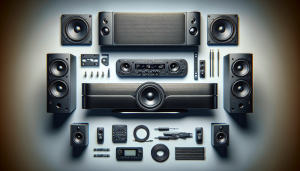
People chase picture, then realize sound brings the emotion. Plan your speakers early. A 5.1.2 or 7.1.4 Dolby Atmos home theater feels lifelike without cranking volume.
Let me explain. The front stage (left, center, right) anchors dialogue and action. Surrounds fill the room. Height channels pull you into the scene. In-ceiling speakers look clean, but on-wall or small bookshelf speakers can sound bigger than you’d expect.
A few friendly picks: Klipsch, KEF, Monitor Audio, Bowers & Wilkins, and SVS all bring strong value. For AVRs, Denon and Marantz offer solid room correction and eARC support. If you want a compact setup, a Sonos Arc with wireless surrounds and sub is simple and still fun.
Pro tip: Don’t bury the center speaker in a cabinet. It needs breathing room for clear dialogue.
Seats, sightlines, and small comforts
You know what? The best seat wins every time. Place your main seat at the ideal distance. Then build around it. If you plan two rows, consider a small riser for the back. Even 6–8 inches high can fix sightlines.
Chairs don’t need to be bulky theater recliners. A slim loveseat and two accent chairs can feel just as premium. Add a throw blanket. A soft rug helps with reflections and comfort. Small touches add up.
Lighting and control: simple beats fancy
Great lighting disappears when the movie starts. Use dimmable cans or LED strips tucked behind molding. Warm white (2700–3000K) keeps skin tones natural. Avoid bright lights near the screen—glare ruins contrast.
Smart control matters. Lutron Caséta dimmers, Philips Hue, or Z-Wave switches play well with remotes and voice. A single “Movie Time” scene that dims lights, closes shades, and powers gear makes everything feel polished without being fussy.
Cable management and power protection
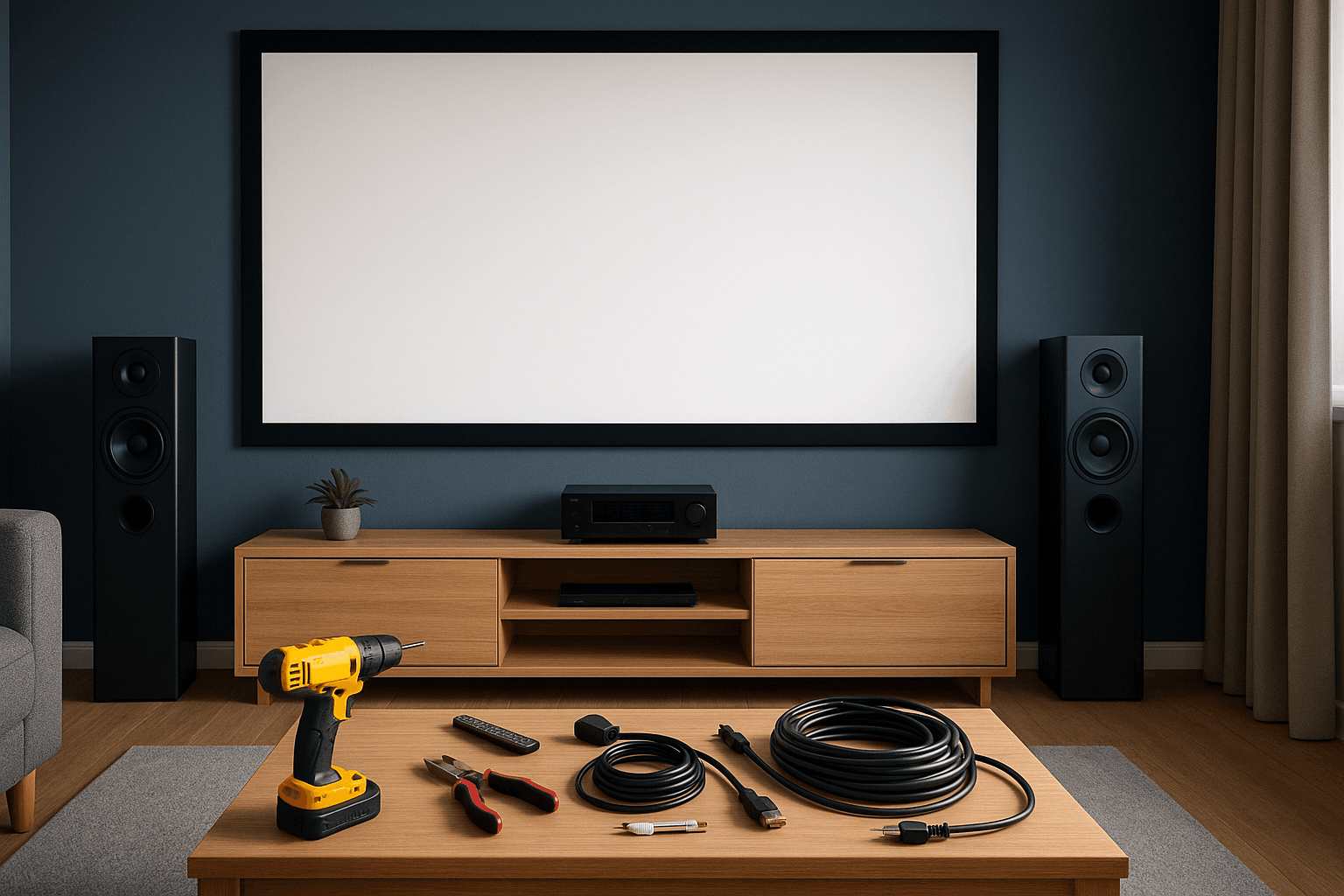
Nothing kills the vibe like a cable web. Plan your runs while the walls are open if you can. Use in-wall rated speaker wire (CL2/CL3) and conduit for future needs. For long HDMI runs, go active or fiber. eARC from the TV to the receiver keeps audio in sync with streaming apps; just label both ends to avoid guesswork later.
Power matters in the mountains. Protect your gear with a quality surge protector or power conditioner. Furman and Panamax are reliable. If you run a projector, a small UPS can save the lamp or laser engine during a blip. It’s a tiny detail that saves a big headache.
Acoustics: the quiet hero of home cinema
This is the secret sauce. Even with great speakers, bare walls cause echoes that blur dialogue. You don’t need a recording studio. A few panels in the right places make a clear difference. First reflections on the side walls and ceiling are the easiest wins. GIK Acoustics and Vicoustic make panels that look like decor, not gear.
If bass feels boomy, you’re hearing the room. Add a second subwoofer if possible—it smooths bass more than it “adds more boom.” Place subs at midpoints of opposite walls or use the “sub crawl” to find the most even spot. It’s not fancy. It works.
Streaming, sources, and your network
A steady network is the backbone of home cinema installation today. Run wired Ethernet to your AVR or streaming boxes if you can. Wi‑Fi has improved, sure, but 4K HDR streams stay happier on a wired link.
We trust Apple TV 4K, Roku Ultra, and Nvidia Shield for clean interfaces and wide app support. A UHD Blu‑ray player still looks best for blockbuster movie nights—disks keep the highest bitrates and Dolby TrueHD audio.
One note: If you own a newer TV with great apps, use eARC from the TV to the receiver so you get full Atmos audio from Disney+, Netflix, and Max.
Smart home integration without the headache
Living along the Wasatch, people love smart homes that don’t need babysitting. Tie your theater to the rest of the house only where it helps. Shades close when “Movie Time” starts. The doorbell shows on-screen without blasting the sound. The thermostat eases back during late-night shows. That’s it. Useful, simple, quiet in the background.
AZP Home Theaters & Automation can integrate Control4 or similar systems so your gear plays nice together. We’ll also keep a clean manual mode for guests and grandparents—because easy is everything.
Budget smart: where to spend, where to save
Here’s a simple framework for Home Theater Installation Salt Lake City budgets:
- Spend on speakers and room treatment: Sound lasts a decade or more; panels don’t go out of date.
- Buy a solid midrange AVR: HDMI standards change. Pick something reliable today, upgrade later if you need more ports or formats.
- Get the right screen: A decent projector on a great screen looks better than a great projector on the wrong screen.
- Plan wiring and power once: It’s cheaper to run extra conduit now than to open walls next year.
You don’t need to spend like a commercial theater to get goosebumps. You just need smart choices and a tidy plan.
Common mistakes we see in Salt Lake homes
We see a lot of bright rooms with brilliant TVs and reflective coffee tables. That table acts like a mirror. Swap it for a matte surface and boom—better contrast. Another common one: mounting a TV too high above a fireplace. Neck strain isn’t a badge of honor. Keep the center of the screen near eye level when possible; if you must mount high, use a tilt mount that drops the angle.
And yes, we still see soundbars jammed inside cabinets. Let them breathe. Sound needs air, like skis need snow.
DIY or hire it out? A friendly middle path
Honestly, plenty of homeowners can handle parts of the job—mounting a TV, hiding a few cables, setting up streaming. The sticky parts are usually speaker layout, Acoustic fixes, and control systems that behave. That’s where a local team makes it painless. We set it up. You enjoy it. If you want to learn as we go, we’ll walk you through the why behind each choice.
Ready for a home cinema that just works?
If you’re picturing cozy winter movie nights or a big March hoops watch party, AZP Home Theaters & Automation can help design and install a system that fits your room, your style, and your budget. We’re local, we know Utah homes, and we speak plain English with a little tech mixed in.
Call us at 385-475-3549 or Request a Free Quote. Tell us what you want, what you already have, and what you wish it did. We’ll map out a clean plan for your home theater installation in Salt Lake City and handle the details so you can press play without the hassle.