Picture this: the lights are low, popcorn bowls are full, and the first line of dialogue lands exactly where it should—clear, centered, and real. That feeling isn’t magic. It’s smart speaker placement. If you’re a homeowner in Salt Lake City building or refreshing a home theatre setup, you don’t have to chase expensive gear to get goosebumps. Place what you already own the right way, and your room sings. Let me explain how to do it without overthinking the tech—or the tape measure.
Why speaker placement changes everything
Good speakers can sound flat if they’re in the wrong spot. Modest speakers can sound fantastic if they’re in the right one. Placement controls clarity, bass impact, and that wraparound feel we all want from Surround Sound. Move a speaker a few inches, and dialogue pops. Shift your sub, and the couch stops shaking in a weird way and starts feeling tight and controlled.
Here’s the thing: your room is part of the system. Walls, windows, rugs, even that giant sectional on the west wall—they all shape what you hear. Salt Lake homes run the gamut, from cozy bungalows in Sugar House to new builds in Daybreak. Different rooms, same goal: clean, balanced sound that fits your space.
Honestly, smart home theater speaker placement saves you money. You fix the room first. You buy later if you still feel the need.
Map the room before you move a speaker
Start with the big picture. Where will you sit most of the time? That’s your “main listening position.” Aim your front speakers toward that seat, then shape everything around it.
Hard surfaces like big windows or tile floors reflect sound. Thick rugs, fabric couches, and bookshelves help tame echoes. If your room has lots of glass with mountain views—and hey, it’s Utah—consider curtains. Not because they’re fancy, but because they stop that bright splashy sound that makes dialogue tiring.
Quick, practical tweaks homeowners can do today:
- Rug and curtains reduce harsh reflections and soften the room’s tone.
- Move the couch a foot or two off the back wall; bass evens out and feels more natural.
- Pull speakers from walls a few inches; it improves clarity and reduces boominess.
Your front stage: where clarity lives
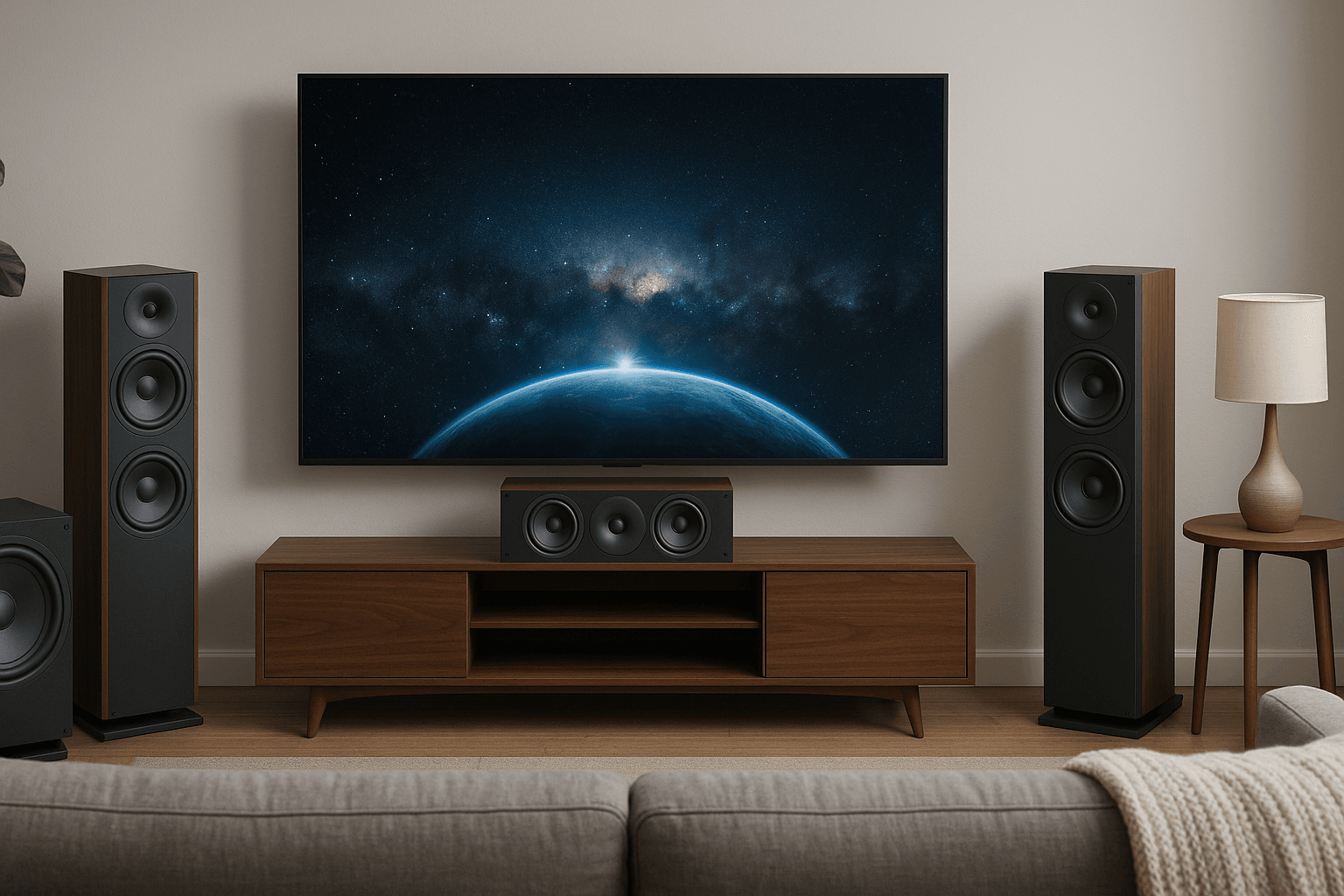
The front trio—Left, Center, Right—does most of the heavy lifting. Think of them as your stage. Keep them consistent in brand or tone so voices don’t change as they pan across the Screen.
Left and Right should sit at about a 22 to 30 degree angle from your seat. If your TV is 8 feet away, that usually means the left and right are 6 to 8 feet apart. Tweeters should be near ear height when you’re seated. A touch of toe-in toward your seat can focus the sound and widen the sweet spot, but trust your ears. Too much and the sound gets sharp. Too little and it goes fuzzy.
Center channel belongs as close as possible to screen height. Above or below is fine when you aim it at your ears. If you ever use an acoustically transparent screen, place the center right behind it at mid-screen height. Dialogue snaps into the picture and stays there.
Surrounds and heights: 5.1, 7.1, and Atmos without the guesswork
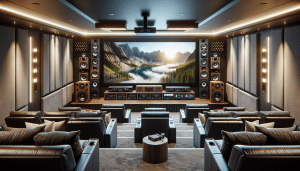
For classic 5.1, put your surrounds slightly behind your seat, about 90 to 110 degrees to your sides, and a little above ear height. If you’re running 7.1, the “surround back” pair sits behind you at about 135 to 150 degrees. Direct-radiating speakers (the regular kind) work well in most homes; bipole/dipole styles can soften the effect in tight rooms.
If you’re adding Dolby Atmos, ceiling speakers go above and slightly forward of the seating area for a 5.1.2 or 5.1.4 layout. Keep them in line with your front speakers and the main seat. On-ceiling speakers beat bounce modules for consistency, but reflected Atmos can still be fun in a room with a flat, low ceiling.
You know what? Even two height speakers add a lot. Four is amazing when you have the space and wiring. If your home has those vaults so common near the Wasatch Front, ceiling placement may need a tweak; flat mounting brackets and careful aiming help a ton.
Subwoofers: smooth bass beats loud bass
One sub can sound great; two can smooth things out across the whole couch. Why? Rooms create peaks and dips that make some seats boomy and others thin. Two subs in smart spots share the load and balance the bass.
Try this classic: the “subwoofer crawl.” Place the sub at your seat. Play a steady bass track. Walk along the room’s front wall and corners. Where it sounds tight and even, park your sub there. It looks odd while you’re testing, but it works.
Corner placement often boosts output; mid-wall positions can even out response. Use your receiver’s distance and level settings to blend the sub with the front speakers. If you have a system with Dirac Live, Audyssey, or Anthem ARC, let it measure and trim, then fine-tune by ear.
- Small room tip: turn the sub’s crossover up high and let the AVR handle bass management.
- Phase control: if voices sound thin, flip phase from 0 to 180 or sweep it slowly to see where bass fills in.
Quick angle and height cheat sheet
These numbers aren’t laws. They’re a smart starting place for speaker placement Salt Lake City homeowners can use in real rooms.
| Channel group | Angle from center | Height vs. seated ear |
|---|---|---|
| Left/Right | 22–30 degrees | At ear height |
| Center | 0 degrees | As close to screen center as possible |
| Surrounds (5.1) | 90–110 degrees | 6–18 inches above ear |
| Surround back (7.1) | 135–150 degrees | 6–18 inches above ear |
| Atmos heights | Above and slightly forward | Ceiling or high on-wall |
| Subwoofer | N/A | Floor; test with crawl method |
Distances, toe-in, and calibration that actually helps
Most receivers ask for distances. Enter the real tape measure numbers first. Let the auto-calibration run, then check what it changed. If it pushed the sub distance far beyond the real number, that’s normal; it’s compensating for processing delay. Leave it unless bass timing feels off.
Level-match your speakers. A simple SPL meter app gets you close; a handheld meter like the MiniDSP UMIK-1 with free REW software goes deeper. Calibrate each speaker to about 75 dB at the main seat using your receiver’s test noise. Small detail, big reward.
Audyssey (Denon/Marantz), YPAO (Yamaha), Dirac Live, and Anthem ARC are all solid. Run the app, take measurements around your main seats, and listen. If it sounds dull, raise the high-frequency target a bit. If bass is heavy, trim the sub level a notch. You’re not cheating; you’re tailoring.
Real homes, real quirks around Salt Lake City
Basement theaters are common here, and they’re great—dark and quiet. But concrete walls reflect bass, creating strong peaks. Two subs help a lot down there. If your space is a main-floor family room with a fireplace and windows, put the center just below the TV and aim it up slightly. A low-profile center stand or foam wedge works wonders.
Townhomes near downtown sometimes share walls. Keep surrounds a bit lower and closer to seating for a focused bubble without rattling the neighbors. For vaulted ceilings in areas like Sandy or Herriman, consider angled in-ceiling mounts for Atmos so the sound points to the seats instead of the stars.
Winter movie marathons after a powder day? Seal wall plates and use CL2/CL3 in-wall cable to avoid crackly connections over time in our dry climate. Small detail, long-term payoff.
Stands, mounts, and cable sanity
Front speakers on solid stands feel tighter than speakers sitting on a flimsy shelf. Aim for ear-height tweeters. Use isolation pads under speakers on cabinets to cut vibration. Wall-mount surrounds with a slight angle toward the seating, not just flat on the wall.
For wire, 12 or 14 AWG copper is great for most runs. Keep it tidy. If it goes in-wall, use properly rated CL2 or CL3 cable. Label each end. You’ll thank yourself during football season when you’re re-routing gear and trying not to miss kickoff.
And one small safety note: secure tall speakers so kids and pets don’t topple them. A discreet strap can save a lot of heartache.
When DIY hits a wall, get local help that listens
You can do a lot with careful home theater speaker placement. But if you’d rather skip the trial and error, we get it. At AZP Home Theaters & Automation, we’ve tuned rooms all over Salt Lake City—from compact condos near the U to big family rooms in South Jordan. We measure the room, place and aim speakers, calibrate your system, and then sit with you to make sure it feels right. Not just measured right—felt right.
Ready to make movie night sound like the theater without leaving home? Call us at 385-475-3549 or Request a Free Quote. We’ll help you channel your space into great sound, whether it’s for Jazz games, summer blockbusters, or that Sunday morning playlist when the house is quiet.