If you’ve ever hung a flat-Screen, queued up your favorite playlist, and then thought, “Why doesn’t this sound as good as I imagined?”—you’re not alone. Great gear helps, but the secret to great sound at home is how that gear lives in your space. Around Salt Lake City, from Sugar House bungalows to new builds in Daybreak and big family rooms in Draper, we see the same handful of missteps. The good news? They’re easy to dodge once you know them. Let’s clear the path so your system sounds rich, tight, and like it was made for your home.
Start With the Room, Not the Carton
Here’s the thing: the room is part of your system. A reflective great room with hard floors will brighten the sound. A basement with plush carpet and a big sectional will soak up highs and leave the bass boomy. Before picking speakers, get a feel for your space.
Simple checks help. Clap your hands; if the echo lingers, you’ll need soft surfaces. Measure the main listening distance. Is it 8 feet? 12? That number shapes speaker size and placement. In open Salt Lake layouts, sound can drift toward the kitchen—nice for background music, not so great for focused listening.
Quick Room Snapshot
- Size and shape — Long, narrow rooms concentrate bass; square rooms exaggerate it. Odd shapes help.
- Surfaces — Large windows, tile, and bare walls reflect; rugs, curtains, and bookshelves calm the room.
- Seating — Where heads land matters. Aim to place ears away from the exact center of the room.
Want to go deeper without getting lost? A free tool like REW (Room EQ Wizard) with a basic USB mic shows where the bass piles up. Not your thing? No worries—our team runs these tests during a consult, so your plan fits your room, not someone else’s lab.
Speaker Placement Myths That Ruin Great Systems
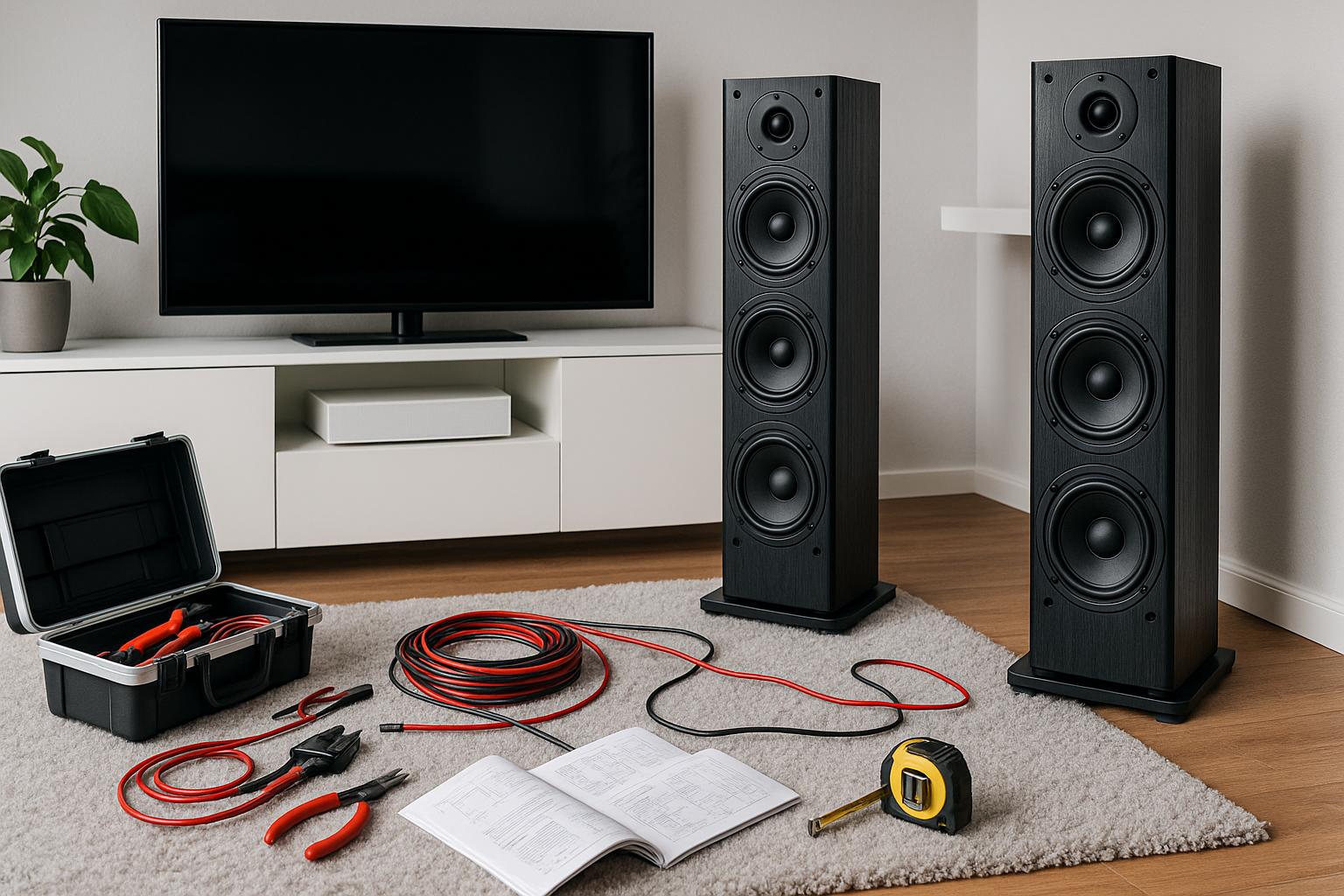
Even premium speakers can sound flat if they’re crammed against a wall or stuck in a corner. You don’t need a blueprint—just a few friendly rules.
- Form the triangle — Left and right mains and your head should make an equilateral triangle. It’s simple and powerful.
- Mind the height — Keep tweeters near ear level while seated. In-ceiling speakers for fronts are handy but not ideal for Surround Sound imaging.
- Give them air — Rear-ported speakers usually need 6–24 inches from the wall. Front-ported or sealed designs can tuck closer.
- Toe-in with care — Aim speakers almost at your nose, then back off a touch if the highs feel sharp.
Subwoofers deserve a quick word. Corners boost bass but can make it boomy. Try the “sub crawl”: put the sub where you sit, play bass-heavy music, and walk the room. Where it sounds tight, place the sub there. Yes, two smaller subs often beat one big one—smoother bass across seats, especially in long basements common around the Wasatch Front.
Brands like SVS, KEF, Klipsch, and Polk all work well when set up right. The trick is matching them to the room and the rest of your system. That’s where good placement does heavier lifting than you’d think.
The “Invisible” Stuff: Power, Wiring, and Noise
It’s not glamorous, but cabling and power make or break a system. We see a lot of Salt Lake remodels where lovely rooms hide poor wiring. Then someone turns up the volume and hears hum—or worse, dropouts.
- Use proper wire — For in-wall runs, go with CL2 or CL3 rated 12/14-gauge cable. It’s safer and code-friendly.
- Label everything — Wall plates, rack gear, and speaker cables. Saves hours later—no guesswork, no swearing.
- Plan for distance — Long HDMI runs? Choose active optical HDMI or an HDBaseT extender from brands like AudioQuest, Monoprice, or Atlona.
- Tame the hum — Avoid sharing circuits with big appliances. Ground loops are sneaky; a simple isolator can fix that buzz.
- Network it right — Hardwire stationary streamers. Mesh Wi‑Fi (Eero, Ubiquiti) is solid, but wires still win for whole-home audio.
Pro tip we use on every job: leave a service loop behind gear. Future you—or we—will thank you when it’s time to add a new streamer or AVR. Also, consider a slim conduit from the TV location to the equipment spot. Swapping cables later goes from “ugh” to easy.
Calibration Isn’t Extra. It’s the Finish Line.
You can nail placement and wiring, then miss the last 10 percent: calibration. Most modern receivers include smart tools. Let them work, then tweak with human ears.
- Room EQ matters — Audyssey (Denon/Marantz), Dirac Live (NAD, Onkyo, Arcam), and YPAO (Yamaha) do real work. Take multiple mic readings around your main seats.
- Set crossovers well — 80 Hz is a reliable start for most speakers. Don’t fear higher settings for small satellites.
- Match levels — Ensure every speaker plays at the same volume. Your center channel can sit 1–2 dB hot for clearer dialog—especially during Jazz games when crowd noise jumps.
- Dial the sub — Start with gain at noon, adjust phase for the fullest bass at the crossover point, then run EQ again.
Advanced users love REW, miniDSP, and UMIK‑1 mics. If that sounds like homework, we get it. Our calibrations blend science with seat time, so music feels alive and movie soundtracks hit with intention, not chaos.
Future-Proof Without Going Overboard
Future-ready doesn’t mean a packed equipment rack. It means smart pathways and room to grow. Choose an AVR or processor that supports the formats you actually need—4K (or 8K if you’re already there), eARC, and your streaming ecosystem of choice.
If Atmos is a “maybe later,” we’ll run extra in-ceiling wire now and cap the plates. Same goes for outdoor zones; a simple prewire to the patio or pergola keeps summer upgrades easy. Rack space, ventilation, and accessible power are your quiet heroes here.
| Room size | Speaker style | Subwoofer guide |
|---|---|---|
| Small den or office | Bookshelf + compact center | 1 compact sealed sub |
| Medium family room | Floorstanders or strong bookshelves | 1–2 10–12 inch subs |
| Large open concept | Robust towers + dedicated center | 2 subs for smooth coverage |
For streaming, Sonos remains easy and reliable. Bluesound fits higher-res folks and plays nice with Roon. AirPlay 2 works for iPhone families; Chromecast suits Android homes. Your choice should fit how you live, not just a spec sheet.
Style Counts: Make It Look Intentional
Sound is the star. But looks set the mood. We tuck wires so nothing distracts, color-match grills to ceilings, and design shelves or built-ins that make gear feel curated, not crowded.
- In-ceiling and on-wall — Great for clean living rooms; KEF and Episode make paintable grills that vanish nicely.
- Furniture matters — Solid media consoles reduce rattles. Open backs help gear breathe.
- Mounting done right — Use proper anchors and lag bolts, especially in older Sugar House walls or newer metal-stud townhomes.
You know what? When a room looks calm, it sounds calmer too. Your eyes stop searching for clutter, and your ears relax. Silly, but true.
Local Wrinkles We See Around Salt Lake City
Every region has quirks. Along the Wasatch Front, we notice a few patterns:
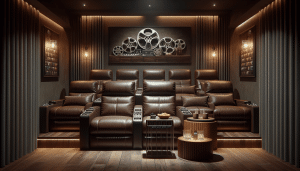
- Basement theaters — Fantastic for dark, quiet spaces. Watch for low ceilings; Atmos channels need smart placement and angled in-ceilings.
- Dry air — It’s hard on wood cabinets. Keep speakers off baseboard heaters and give them breathing room.
- Older homes — Lath-and-plaster with fire blocks can turn a simple wire pull into a puzzle. We map stud bays and use fish tapes and rods that won’t damage walls.
- Townhome walls — Shared walls amplify bass. Bass traps and dual-sub smoothing help keep peace with neighbors and HOAs.
- Code and safety — Low-voltage lines should be CL2/CL3 rated and maintain separation from AC lines. We also seal fire stops as required.
From Bountiful to Herriman, we aim for systems that suit real life—winter movie marathons, patio playlists in June, and yes, Sunday resets with soft jazz while you cook.
Fast Fixes: The Common Mistakes to Avoid
- Buying gear before measuring the room — The room shape and seating guide everything else.
- Shoving speakers into corners — Easy to do, hard on clarity. Give them space.
- Ignoring the subwoofer’s spot — Use the crawl test. It works, every time.
- Running skinny wire for long distances — Use 12/14-gauge in-wall rated cable and label both ends.
- Skipping calibration — Even a 10-minute Audyssey or YPAO pass lifts the system.
- Underestimating the network — Hardwire key devices; Wi‑Fi is busy in dense neighborhoods.
- No plan for tomorrow — Add conduit and a few spare wires while walls are open. Cheap now, priceless later.
None of this needs to be complicated. It just needs to be considered. A little planning keeps your system from fighting the room—and lets your room work with your system.
When To Call a Pro—and How AZP Makes It Simple
If you’re setting up a soundbar and a sub, a Saturday afternoon might do it. If you’re wiring a family room, adding Dolby Atmos, or tying in whole-home audio, that’s where AZP Home Theaters & Automation steps in. We bring test mics, Fluke meters, and a lot of local experience. More important, we listen—to the room and to you.
Our process is clear and friendly. We start with a conversation and a walk-through. We design around your space, your style, and your budget. We install with clean cable runs, code-safe wiring, and careful labeling. Then we calibrate. We don’t leave until your favorite song feels like it’s breathing in the room, and dialog sounds crisp even at family-friendly volumes.
Thinking about a new system or a tune-up for what you’ve got? Let us help you avoid the common traps and enjoy the fun part: rich, effortless sound that just works.
Call AZP Home Theaters & Automation at 385-475-3549 or tap Request a Free Quote to get started. We serve Salt Lake City and nearby communities—Park City, Sandy, Draper, Sugar House, Bountiful, and more. One call, and your system starts sounding the way it should.