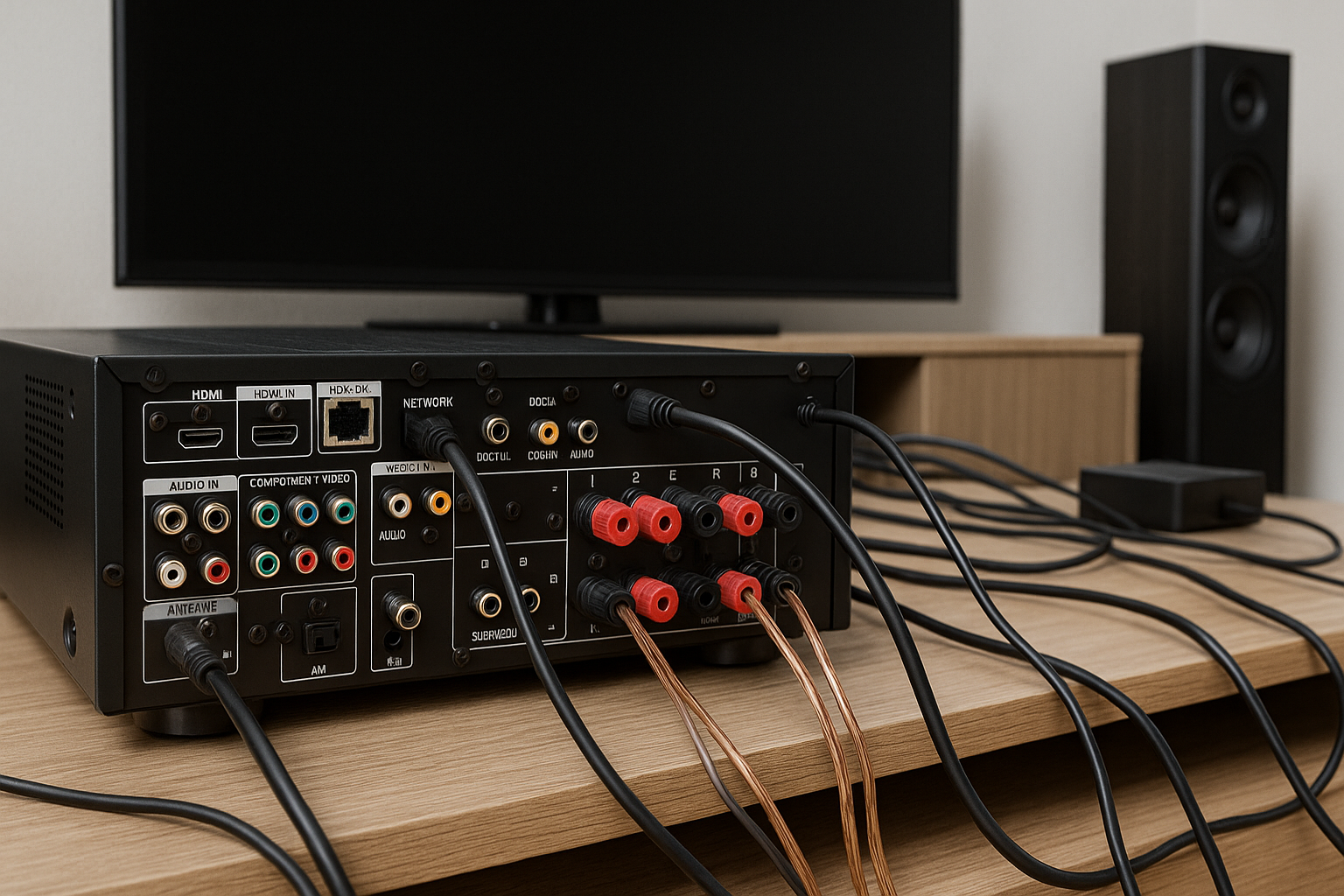
Imagine settling in for a movie, only to spot a tangle of cables snaking behind your cabinet. It’s distracting. It’s confusing. And if we’re being honest, it’s the reason the soundbar sometimes won’t sync with the TV. You know what? It doesn’t have to be that way. At AZP Home Theaters & Automation here in Salt Lake City, we simplify home theater wiring so your system just works—beautifully and predictably—without the spaghetti mess.
Why does wiring feel complicated? Because devices multiply fast
If your living room hosts a streaming box, a game console, a turntable with a phono preamp, a cable box, and maybe a Blu-ray player you still love—yeah, things add up. Add a Projector in the basement and a couple of Dolby Atmos speakers up top, and suddenly the cabling feels like a puzzle with missing pieces.
Here’s the thing: when we reduce the system to a few clean paths, everything gets easier to manage. For most homes, the blueprint looks like this: sources to a receiver, receiver to display, speakers to receiver, network to everything. Keep those lanes clear, and the picture stays bright, the sound stays tight, and the remote doesn’t become a four-letter word.
Start with a clean signal path: HDMI made friendly
Let me explain the simple version. Your sources (Roku Ultra, Apple TV 4K, PS5) connect to your AV receiver (AVR). The receiver sends one cable—usually HDMI 2.1—to your display. That’s your backbone. For sound from built-in TV apps, enable ARC/eARC. That single HDMI connection handles audio both directions when set up correctly.
We do pay attention to cable length. Short runs under 15 feet? A certified Ultra High Speed HDMI cable from brands like AudioQuest, Blue Jeans Cable, or Monoprice is rock solid. Long runs to a projector or a TV across the room? We use active HDMI, fiber HDMI, or HDBaseT extenders for 4K and even 8K signals without glitches. Avoid the too-cheap switchers and splitters; they cause handshake errors and EDID weirdness that make devices “forget” each other. Not fun.
Below is a quick reference for common needs:
| Use-case | Best cable/tech | Notes |
|---|---|---|
| TV to AVR with TV apps | HDMI 2.1 with eARC | Enable eARC in both menus; turn off flaky CEC features if needed. |
| Long run to projector | Active/Fiber HDMI or HDBaseT | Stable 4K HDR over distance; keep bends gentle. |
| Multiple sources to one display | AVR or quality HDMI matrix | Prefer AVR switching over bargain splitters. |
Honestly, most “mystery” HDMI issues in Salt Lake homes trace back to one thing: mismatched settings. We fine-tune CEC, HDR, and frame rate so your Sony, LG, or Samsung TV plays nice with your Denon, Marantz, or Yamaha AVR.
Speaker wiring without the mystery
Good speaker wire is simple: correct gauge, clean terminations, and polarity. For front LCR and sub-to-amp runs, we recommend 12–14 AWG oxygen-free copper. Surrounds and heights can use 14–16 AWG depending on distance. In walls, use CL2/CL3-rated cable; for return-air spaces, we may use CMP (plenum) to meet code.
Polarity matters. Red to red, black to black. If one speaker flips polarity, bass gets thin and imaging fades. Banana plugs or spade connectors keep things tidy and secure. Planning for Dolby Atmos? We’ll snake ceiling runs neatly and land them at clean wall plates or an equipment rack so maintenance is easy later.
For subwoofers, we like quality RCA or coaxial LFE cables. Wireless subs can work too—handy in tight rooms—but we’ll check for interference and latency before greenlighting that path.
A few common gotchas we watch for:
- Running speaker wire parallel to power for long distances — can introduce hum; we cross at 90 degrees or separate paths.
- Mixing copper-clad aluminum (CCA) with real copper — CCA looks cheap now, costs you performance later.
- Jamming wire behind trim — pinched wire equals intermittent sound and a headache later.
Solid streaming needs solid networking
4K streams sound and look amazing—until the Wi‑Fi drops. We design a simple rule for reliability: wire what stands still. We hardwire TVs, AVRs, game consoles, and streaming boxes with Cat6 or Cat6A. Save Wi‑Fi for tablets and phones. If coverage is spotty in your Sugar House bungalow or your Daybreak new build, we’ll place PoE access points in the right spots and connect them to a quiet network switch.
For long future-proof runs, especially between floors or across large basements, we sometimes pull fiber as a backbone. It doesn’t pick up interference, and it laughs at long distances. Small detail, big difference.
We also avoid running Ethernet alongside electrical lines for long distances. Separation keeps noise down. If we must cross, we cross quickly and cleanly.
Retrofits vs. new builds in Salt Lake City: different roads, same destination
Older homes on the east bench, cozy bungalows in the Avenues, new townhomes in South Jordan—each needs a different touch. Retrofits are a mix of careful fishing and creative pathways. We use attic access, unfinished basements, and flexible drill bits to reach the right spots with minimal patching. Sometimes a low-profile raceway along a baseboard looks better and cleaner than opening a wall; we choose what respects your home first.
New builds? That’s our playground. We coordinate with your builder to run structured wiring—home runs of Cat6, coax, and speaker wire—back to a central rack. We like to add conduit to key locations (behind the TV, to the projector, to the exterior for satellite or Starlink). Conduit is cheap insurance for whatever comes next: new formats, faster standards, or that gaming console your kids will swear they need.
And yes, we follow NEC guidelines and local codes. When a permit is required, we help handle it. Clean. Legal. Safe.
Labeling, racks, and power: boring heroes that save the day
Nothing beats a neat rack and well-labeled terminations. We label both ends of every run with durable heat-shrink tags—source and destination. We bundle cables with Velcro, not zip ties, so service is easy. For racks, brands like Middle Atlantic keep equipment cool and accessible. Venting matters; AV gear likes to breathe, especially receivers that push real power.
Power protection is the other quiet hero. We use surge protection and power conditioning from companies like Panamax or Furman to keep noise down and your investment safe from spikes. If you own a projector, a small UPS lets the lamp cool properly during outages. It’s a small thing you’ll be grateful for during a summer thunderstorm.
Smart control so everything just works
One remote, simple buttons, zero stress. That’s the goal. We design systems around Control4 or URC for whole-home reliability. Prefer a simpler stack? We’ll set up a streamlined universal remote and configure HDMI-CEC where it helps—and disable it where it hurts. Scenes like “Movie Night” dim the Lutron lights, lower the shades, set the AVR input, and cue the streaming app. If you like voice control, we integrate Alexa or Google Assistant with clear commands that don’t trip over each other.
And yes, we document the setup. If you ever want to add a second zone on the patio or a turntable in the study, changes are smooth because the foundation’s tidy.
Seasonal twist: winter marathons and summer sports
Salt Lake winters encourage couch time—Jazz games, ski films, family marathons. Summer brings baseball, backyard screens, and big match replays in the cool basement. We plan for both. Outdoor-rated HDMI and power for patio TVs, proper speaker placement for dialogue clarity during those late-night thrillers, and easy input toggles for when friends bring a Switch over. It’s the small quality-of-life touches that make the system feel personal.
When should you bring in a pro?
If you’re adding ceiling speakers, pulling wire across finished rooms, hanging a heavy TV on a tricky wall, or chasing a ghostly HDMI issue—call us. If we hear “it worked yesterday” or “only Netflix is silent,” we know exactly where to look. We also handle trickier cases: older plaster walls, tight stairwells, shared walls in townhomes, and equipment closets that run hot.
We work across Salt Lake County and beyond, from Holladay to Herriman. We tidy what you already have, or we start fresh with a system that respects your budget and your time.
Quick reference: what we install most for SLC homeowners
- Wall-mounted TVs with hidden wiring — HDMI and power concealed, soundbars or discrete speakers synced.
- Basement theater packages — projector, Screen, 5.1.2 or 5.1.4 speakers, simple control, dark-room calibration.
- Living-room-friendly Atmos systems — compact speakers, clean wire paths, strong dialogue clarity.
- Structured prewire for new builds — Cat6, coax, speaker wire, and conduit to a tidy rack.
- Network upgrades — reliable streaming with wired backbones and well-placed access points.
If you’re curious about brands, we regularly work with Denon, Marantz, Yamaha, Sony, LG, Samsung, Epson, JVC, Sonos, KEF, Klipsch, and more. But we design around your room first, gear second.
Ready to enjoy movie night without the mess?
If your system looks complicated, we’ll make it simple. If it already works, we’ll make it neater. Either way, you get a clean setup that sounds fantastic and feels easy every time you hit play. Call AZP Home Theaters & Automation at 385-475-3549, or Request a Free Quote. We’re local, friendly, and we show up with solutions—so you can sit back, press one button, and enjoy the show.