Imagine movie night where the room itself feels like part of the story. Helicopters sweep overhead. Quiet dialogue stays crisp. Bass lands with a gentle thump instead of rattling your windows. That’s what a well-set Surround Sound installation can do. If you’re a homeowner in Salt Lake City, UT, this beginner’s guide from AZP Home Theaters & Automation will help you plan a system that fits your space, your budget, and your weekend plans—without getting lost in tech jargon.
So what is surround sound, really?
Let me explain. “Surround” just means audio comes from more than the TV’s speakers. A basic setup is 5.1: five speakers and one subwoofer. Add two more speakers behind you and you’ve got 7.1. Want height and that “above you” feeling? That’s Dolby Atmos—often written as 5.1.2 or 5.1.4 (the last number is the number of height speakers).
You don’t need a massive room. You don’t need a Hollywood budget. You just need a plan that matches your space and your expectations—and a little patience during setup.
| System | Speakers | When It Fits |
|---|---|---|
| 5.1 | Front L/R, Center, 2 Surrounds, 1 Sub | Living rooms, townhomes, basements |
| 7.1 | 5.1 plus 2 rear surrounds | Long rooms with a defined back wall |
| 5.1.2 Atmos | 5.1 plus 2 height channels | Rooms with flat ceilings; modern TV rooms |
Here’s the thing: Atmos isn’t only for “theater rooms.” Even in a Sugar House bungalow or a Daybreak family room, two height channels can add a surprising sense of space.
Start with your room (yes, the room decides more than the gear)
Your room shapes the sound more than most people expect. Hardwood floors in a Yalecrest home? You’ll hear more echoes. A cozy basement near Liberty Park? Probably more bass buildup. None of this is a deal-breaker—it just guides the plan.
Quick room checks we do in Salt Lake City homes:
- Seating distance: If you sit 8–10 feet from the TV, a 5.1 or 5.1.2 works beautifully. Farther back? Consider 7.1 or larger front speakers.
- Ceiling type: Flat ceilings under 10 feet are perfect for Atmos. Vaulted ceilings can still work with in-ceiling speakers placed near the seating area.
- Open floor plan: If your living room opens to the kitchen (very common along the Wasatch Front), choose speakers with controlled dispersion and a subwoofer you can place near a corner for smoother bass.
- Hard vs soft surfaces: Add a rug, thicker curtains, or a bookcase to tame echoes. Small tweaks; big payoff.
You know what? The dry climate here helps a bit—less humidity means fewer creaks and rattles from wood. Still, every room behaves a little differently, which is why we test and tune on-site.
The gear you need—without the stress
Let’s keep it simple. For a beginner-friendly home theater setup, you’ll usually want:
- AV receiver: The brain. Look for 4K/8K HDMI, eARC, and room correction (like Audyssey, YPAO, or Dirac). Denon, Yamaha, Sony, and Onkyo all make solid options.
- Speakers: Front left/right, center, two surrounds. Brands like Klipsch, Polk, ELAC, and SVS offer good value. Keep the left, center, and right from the same series so voices sound natural.
- Subwoofer: This fills in the low notes. Start with a single 10 or 12 inch sub; add a second later if the room is large or bass is uneven.
- Cables: Decent 14 or 16 gauge speaker wire and certified Ultra High Speed HDMI. Not fancy, just reliable.
- Mounts and stands: Wall mounts for surrounds, a center-channel shelf or stand, and a TV mount with a modest tilt.
Thinking wireless? Sonos and HEOS can be convenient, but true surround sound installation still benefits from wired speakers for the front stage. You can mix approaches though: wired fronts, wireless rears. Honestly, it’s less complex than it sounds.
Speaker placement that actually works
Placement is half the magic. Small moves change everything.
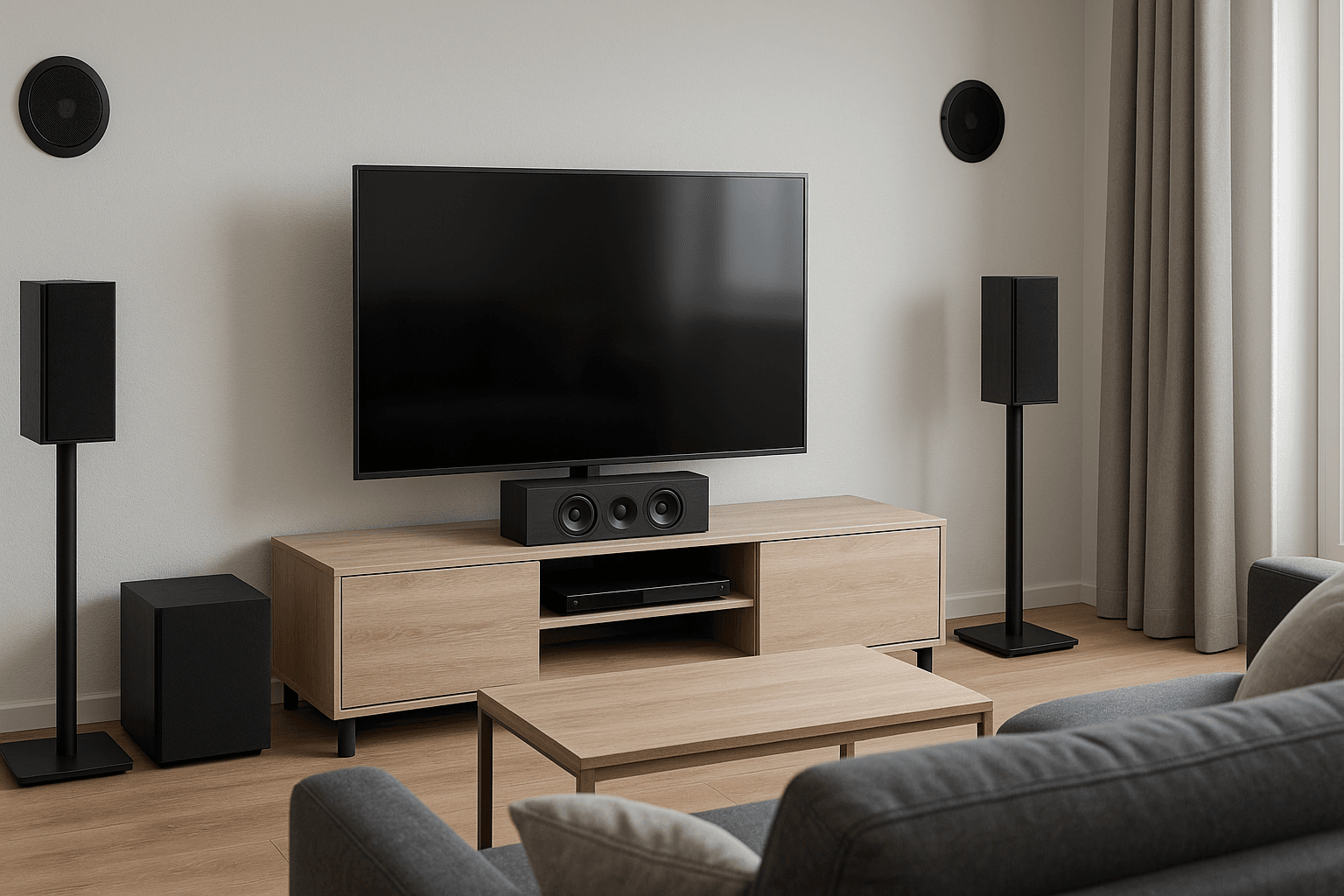
- Front left/right: About ear height, forming a 22–30 degree angle from your seat. Don’t push them into the corners; give them a little breathing room.
- Center: Directly under or above the TV, tilted toward your ears. If voices seem thin, raise the level a notch or two in the receiver menu.
- Surrounds: Slightly behind or to the side of your seating—roughly 90–110 degrees from center. Keep them at or just above ear height.
- Subwoofer: Start near the front wall or a front corner. If bass feels “boomy,” move it 6–12 inches away from the wall. Try the “subwoofer crawl” trick to find the smoothest spot.
- Atmos height speakers: In-ceiling about 2–3 feet in front of the main seats, spaced left/right to match your fronts. If you’re using upward-firing modules, place them on top of the front speakers and avoid tall shelves that block the bounce.
There’s a contradiction here: surround speakers should be subtle, yet you’ll miss them when they’re wrong. That’s because our ears are sensitive to where sound comes from. Get those angles close and the whole room snaps into focus.
Wiring made simple: clean, safe, and future-friendly
Running wire looks hard. It isn’t—until it is. Fish tape, baseboards, and paintable raceways are your friends. When we install in Salt Lake City homes, we often run rear surround lines under baseboards or through a closet, then pop out exactly where the speaker sits. Neat and tidy.
Prefer wireless rears? Look for reliable transmitter kits like SVS SoundPath or Amphony. They still need power at the speaker location, but they save the cable run. Just watch for interference from Wi‑Fi and microwaves.
A quick safety note: in-wall rated cable and proper plates keep things code-compliant, tidy, and safer long-term. We also check for studs, electrical lines, and plumbing before any cut. No guesswork.
Calibration: the 20-minute upgrade
Most receivers include auto-setup. Use it. The small microphone and a quiet room can fix the big stuff fast.
- Mic positions: Take at least three readings around your main seat. Five is better.
- Speaker size: Set all speakers to “Small” with an 80 Hz crossover to the sub. Yes, even big towers. Let the sub handle the deep lows.
- Levels and distance: Confirm each is reasonable. If the center is still soft, bump it +1 or +2 dB.
- Subwoofer phase: Try 0 and 180 degrees. Pick the one with smoother, tighter bass.
- TV audio settings: Use Bitstream with Dolby enabled; turn on eARC if available. Avoid PCM for streaming movies—it flattens surround.
Test with a scene you know—maybe a Utah Jazz game in Dolby audio or a favorite movie like Top Gun: Maverick or Dune. If you feel more “in” the action, you did it right.
Common pitfalls we fix every week
Don’t worry—everyone runs into these. A few quick saves:
- Center channel buried: It’s often sitting too low or firing at your knees. Tilt it up and raise the level.
- All bass, no detail: Lower the sub gain and let the receiver send 80 Hz and lower to the sub. That cleans up the mids.
- Atmos not working: On many TVs, eARC must be enabled. In apps, select Dolby Atmos. On receivers, assign your height channels correctly.
- Rear surrounds too far back: Pull them closer to the seating line. You should sense them—not chase them.
- Cables mislabeled: Label everything at both ends. Future you will be grateful.
One more subtle thing: if your room is wide open to a hallway, use slightly stronger surround levels to “fill in” that missing wall. It feels counterintuitive, but it works.
DIY or call a pro? A calm, honest look
You can absolutely build a solid surround sound installation in Salt Lake City on your own. We’ve seen some fantastic DIY rooms. But there are moments when calling AZP Home Theaters & Automation saves time, money, and drywall dust.
- In-ceiling or in-wall speakers: We handle placement, bracing, and clean patching if needed.
- Power behind the TV: Hide cords safely with a recessed kit and proper wiring.
- Room correction tuning: Dirac, Audyssey, and manual EQ can get deep. We tune by ear and by measurement.
- New construction or remodel: Pre-wiring now avoids headaches later—and gives you real flexibility.
It sounds like a sales pitch, but here’s the practical truth: what takes you a weekend can take us a few hours, with cleaner lines and better results. We’ve done it hundreds of times across the valley, from downtown condos to big family rooms in Holladay.
What will this cost? A simple snapshot
Every house is different, and prices move. Still, here’s a helpful ballpark for gear, not including furniture or construction.
| Setup | Typical Gear Range | What You Get |
|---|---|---|
| Starter 5.1 | $1,000–$2,000 | Receiver, compact 5.1 speakers, single sub, cables |
| Mid 5.1.2 Atmos | $2,000–$4,000 | Stronger fronts, in-ceiling or up-firing Atmos, better sub |
| Premium 7.1.4 | $4,500–$9,000+ | Full Atmos with four heights, dual subs, robust receiver |
We also design around what you already own. Got a good sub? Great. Let’s build from that. Prefer small speakers because of the room? No problem. There’s always a path to better sound.
Little extras that make a big difference
We’re fans of small upgrades that punch above their weight:
- Rug and curtains: One rug and thicker curtains can calm reflections and tighten voices.
- TV brightness and motion controls: Match picture presets to the content and disable aggressive motion smoothing for movies.
- Smart control: A single remote or app scene for “Movie Night”—lights dim, receiver on, input set—feels great every time.
- Mount the center correctly: Center that center. Your ears will thank you.
And if you host watch parties for the Jazz, set a “Sports” preset: a touch more center channel for play-by-play, a little extra surround for crowd noise, and the sub at +1 for that arena vibe.
Ready to hear it for yourself?
If you want simple, solid sound or a full Home Theater Installation in Salt Lake City, we’ll make it easy. We can map the room, run wire cleanly, choose the right gear, and tune it so dialogue is clear and the score gives you chills—without rattling the neighbor’s dishes.
Call AZP Home Theaters & Automation at 385-475-3549 or Request a Free Quote. Tell us about your room, your budget, and your must-watch list. We’ll bring the know-how, a friendly plan, and that “wow, I can hear everything” moment.