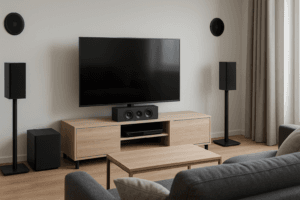
Movie night should feel like magic, not a guessing game with wires and stands. If you’re setting up a home theater in Salt Lake City, you’ve got a few quirks to consider: basements with low ceilings, hard floors that love to echo, open-concept rooms that spill sound into the kitchen. We see it every week. The good news? With thoughtful speaker placement, a bit of calibration, and a few local tricks, your system can punch way above its weight. Here’s how we at AZP Home Theaters & Automation help homeowners tune their rooms so the sound feels natural, exciting, and—let’s be honest—comfy for long binge sessions.
Start With the Room, Not the Speakers
Speakers matter a lot, but the room sets the rules. Along the Wasatch Front, many homes feature big windows, tall ceilings, and beautiful but reflective finishes. That’s stunning for views, not always for audio. Simple fixes shape the sound before you move a single speaker.
Here’s the thing: even small changes make a real difference. A plush rug between the front speakers and your couch can calm reflections. Curtains soften slap-back echo. A filled bookcase on a side wall doubles as a diffuser. If your theater lives in a basement (very common here), watch for boomy bass thanks to small rooms and rigid walls. A couple of Acoustic panels at the first reflection points can reduce that “shouty” midrange without turning your space into a recording studio.
If you’re a measurement-minded listener, try the 38 percent rule as a starting point: place your main seat about 38 percent of the room’s length away from the front wall. It’s not perfect—and we break it all the time—but it usually lands you away from the strongest bass peaks and dips.
The Golden Triangle: Front Left, Center, and Right
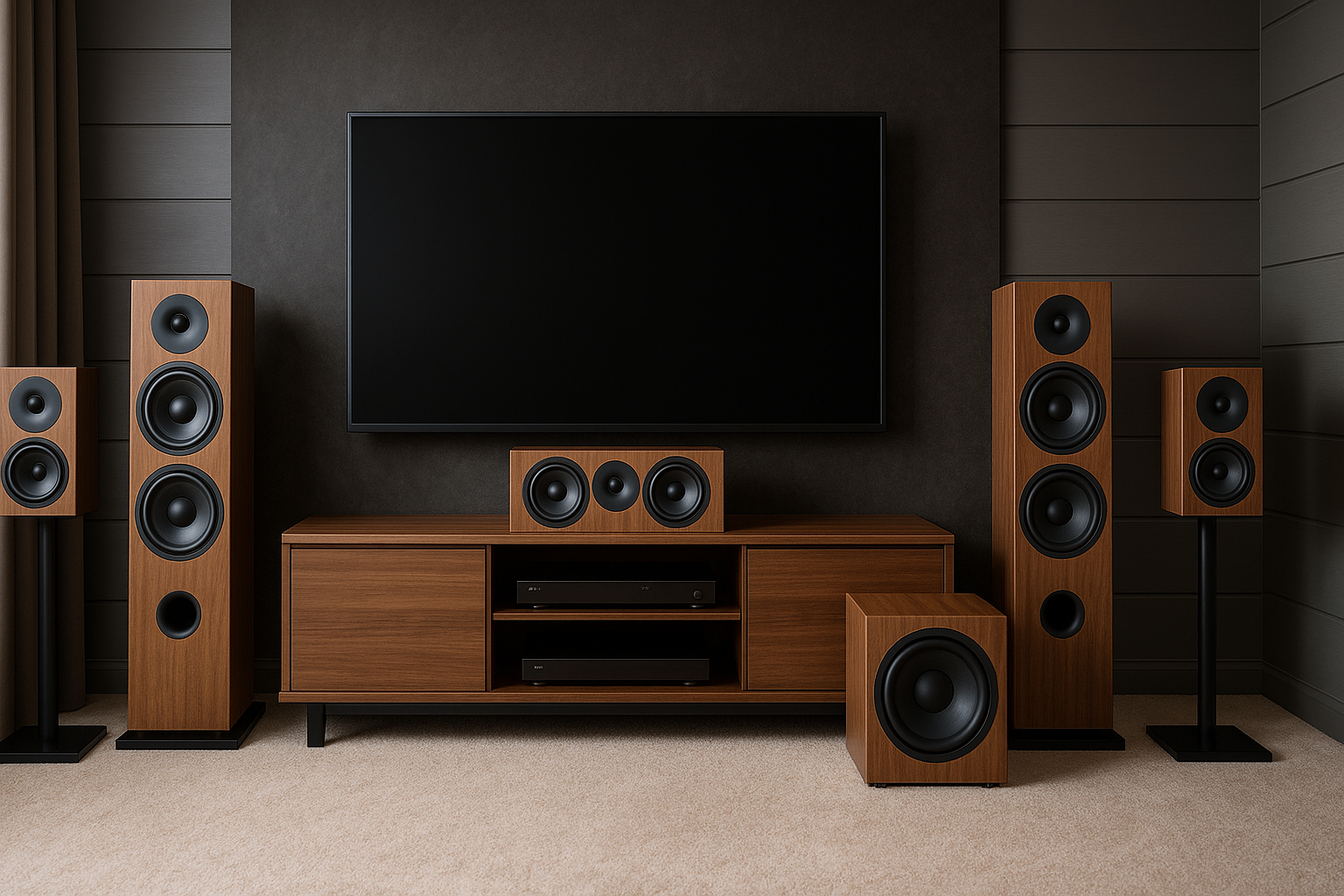
The LCR trio carries voices, music, and most action cues. Get them right, and the whole system wakes up. Sit in your main spot and imagine a triangle: your head is one point, the left and right speakers are the other two. Aim for equal distance from you to each of the front speakers, with the speakers forming a gentle arc around your seat.
Placement tips we use in many Salt Lake City home theater projects:
- Ear-height tweeters: Keep the front left and right tweeters roughly at seated ear height. If they’re lower, give them a little tilt-up.
- Toe-in with care: Angle the speakers slightly toward your seat. Try pointing them just past your shoulders for a broad soundstage without “beaming.”
- Center channel clarity: Place the center as close to ear height as possible. If it must sit below the TV, tilt it toward your nose, not your kneecaps.
- Don’t crowd the wall: Give the front speakers a bit of breathing room from the wall—6 to 24 inches. You’ll gain tighter imaging and cleaner bass.
Now, a tiny contradiction: we love symmetry, but it’s not the law. If your couch lives a few inches off-center to save that walkway, adjust speaker toe-in and levels to re-center the soundstage. Your ears judge the result, not a diagram.
Surrounds That Disappear (In a Good Way)
Great surrounds don’t shout. They wrap. For a classic 5.1 Surround Sound setup, position side surrounds slightly behind your ears at about 90–110 degrees from your nose, and a touch higher than ear height. If you run 7.1, add the rears behind the couch at 135–150 degrees. Salt Lake rooms often push sofas right against a wall—no problem. Go a bit higher on the surrounds (around 1–2 feet above ear height), or consider dipole/bipole in-walls to spread the sound without hot spots.
When space is tight, we’ll often use paintable in-wall speakers from brands like Sonance or Klipsch for a clean, low-profile look that your room—and your partner—will appreciate. You know what? That subtle upgrade alone can make movie nights feel less like a gear demo and more like a private cinema.
Subwoofer Sanity: Clean, Even Bass
Bass behaves badly in rectangular rooms—especially sturdy Utah basements. One seat roars; the other seat yawns. That’s normal. To fix it, start with placement. The “sub crawl” remains a classic: put the sub where you sit, play a bass-heavy track, then walk the room. Where it sounds smooth—not boomy or thin—place the sub there.
Two subs usually beat one for even coverage. They don’t need to be massive; matched models placed at opposite walls or front corners often even out the low end. If you can only run one sub, try the front right corner first, then adjust. And keep HVAC noise in mind—during winter, return vents can rumble, masking low bass. We’ll help you choose a spot that stays quiet even when the furnace kicks on.
Dolby Atmos Without the Headache
Height channels add that “whoa—overhead helicopter” realism. For Dolby Atmos, we like in-ceiling speakers placed slightly forward and behind your main seat, forming a rectangle over the listening area. If your theater ceiling is low or finished with a lovely reclaimed wood pattern, up-firing modules can still deliver a convincing height effect, especially with a reflective ceiling.
Rule of thumb: keep overheads roughly the same distance forward and backward from your seat, and avoid placing them way off to the sides. In many Utah homes with soffits or drop ceilings, it’s easy to sneak in slim in-ceilings that align with the can lights for a neat, architectural look. We’ll map it all out so you get clean lines and clean sound.
Calibrate Like a Pro, Then Trust Your Ears
Even a perfect arrangement needs level-matching and timing. Your AV receiver’s auto-setup (Audyssey, YPAO, MCACC, Dirac Live) is a great start. Place the calibration mic at ear height on a tripod, run multiple positions around your main seat, and let the software measure distances and levels. Then check a few things by ear.
- Crossover at 80 Hz: Set all speakers to “Small” and run an 80 Hz crossover to the sub. Larger towers might like 60 Hz; most in-walls prefer 80–100 Hz.
- Center channel boost: Bump the center +1 to +2 dB for clearer dialogue, especially during action scenes.
- Dynamic EQ thoughtfully: If you watch late at night, a touch of Dynamic EQ can keep the sound full at lower volumes.
- Phase and polarity: If bass feels thin at your main seat, try flipping the sub’s phase from 0 to 180, then pick what sounds tighter.
More analytical listeners sometimes bring out a UMIK-1 mic and REW software to see room peaks and dips. Totally fair—but don’t let graphs steal the show. If voices sound natural and bass feels even across a couple of seats, you’re winning.
Common Mistakes We Fix All the Time Around SLC
We’ve seen some classics. Don’t worry—we’ve made a few in our own homes, too.
- Center channel too low: Under the cabinet, firing at ankles. Tilt it up toward your nose. Dialogue snaps into focus.
- Surrounds too far back: All the action comes from behind your shoulders. Slide them a touch forward or raise them a bit.
- Sub in a “null”: You feel nothing but the walls shake elsewhere. Try the crawl; you’ll find a happier spot.
- Speakers crammed into corners: Bass piles up, mids get muddy. Give them a few inches to breathe.
- Room correction mic on the couch: Cushions skew readings. Use a tripod at ear height for accurate results.
- Polarity flipped on one speaker: The soundstage collapses. Double-check red-to-red, black-to-black at both ends.
Honestly, correcting just one of these can make you blurt out, “Oh—that’s what I was missing.”
Quick Reference: Angles and Heights
Use this cheat sheet as a starting point for a balanced surround sound setup. Adjust by a few degrees or inches as your room demands—your ears will tell you when it clicks.
| Channel | Angle from Listener | Height Tip |
|---|---|---|
| Front Left/Right | 22–30° from center | Tweeters at ear height; slight toe-in |
| Center | 0° (centered) | Close to ear height; tilt if below Screen |
| Side Surrounds | 90–110° | About 1–2 ft above ear height |
| Rear Surrounds | 135–150° | Similar height to sides |
| Atmos (Top Front/Rear) | Above; slightly forward/back of seat | Ceiling placements form a rectangle over seats |
| Subwoofer | N/A | Corner or wall midpoint; try the sub crawl |
Style Matters: Make It Look as Good as It Sounds
Great sound shouldn’t fight your room. In Sugar House bungalows, we often hide front speakers behind an acoustically transparent screen or set slim towers that echo the home’s clean lines. In Daybreak family rooms, paintable in-walls keep sightlines open while kids zoom around. Even simple touches—magnetically attached white grilles, a fabric-wrapped equipment panel, a floating media shelf—bring a polished, custom feel.
We also love using low-profile acoustic panels that look like artwork. Choose colors that nod to Utah’s red rock or the winter blues of the Wasatch. It’s functional, but it’s also you. Because when the room looks right, you sit a little deeper, breathe a little slower, and enjoy a little more.
Ready to Hear the Difference?
If you’re planning a home theater—or your current system just isn’t clicking—AZP Home Theaters & Automation can help. We tune rooms across the Salt Lake Valley every week, from cozy basements to big open family spaces. We’ll map your layout, place your speakers, calibrate your gear, and leave you with a setup that sounds effortless.
Give us a call at 385-475-3549 or Request a Free Quote. We’ll listen to what you want, walk you through smart placement choices, and set you up with a system that makes movie nights, game days, and quiet music sessions feel absolutely right.