You press play. The room goes dark. Then the soundtrack ramps up…and somehow the dialogue gets muddy, the bass booms, and the cool details vanish into a blur. If that sounds familiar, you’re not alone. For many homeowners in and around Salt Lake City, a great Projector and nice speakers still fall short without smart home theater Acoustic treatment. The good news? With a few targeted moves, you can make your space sound like it looks—cinematic, clear, and honestly just more fun to use.
Acoustic Treatment vs. Soundproofing: Not the Same Thing
Let’s clear up one thing before we get too far. Acoustic treatment shapes how sound behaves inside your theater—how clear voices are, how tight the bass feels, how immersive everything seems. Soundproofing is different; it keeps sound from leaking to other rooms (and keeps outside noise from sneaking in). Treatment uses materials like acoustic panels, bass traps, and diffusers. Soundproofing uses mass, isolation channels, seals, and special drywall.
In other words, if your theater is echoey or boomy, you treat. If your neighbors can hear your sub during the fourth quarter—or your kid’s nap gets crushed by movie night—you isolate. Many Salt Lake homes, especially basements with concrete walls, need a bit of both. But if you want to hear crisp dialogue and goosebump-inducing detail, treatment is your first stop.
The Building Blocks: Absorption, Diffusion, Bass Control
Absorption: Calm the Reflections
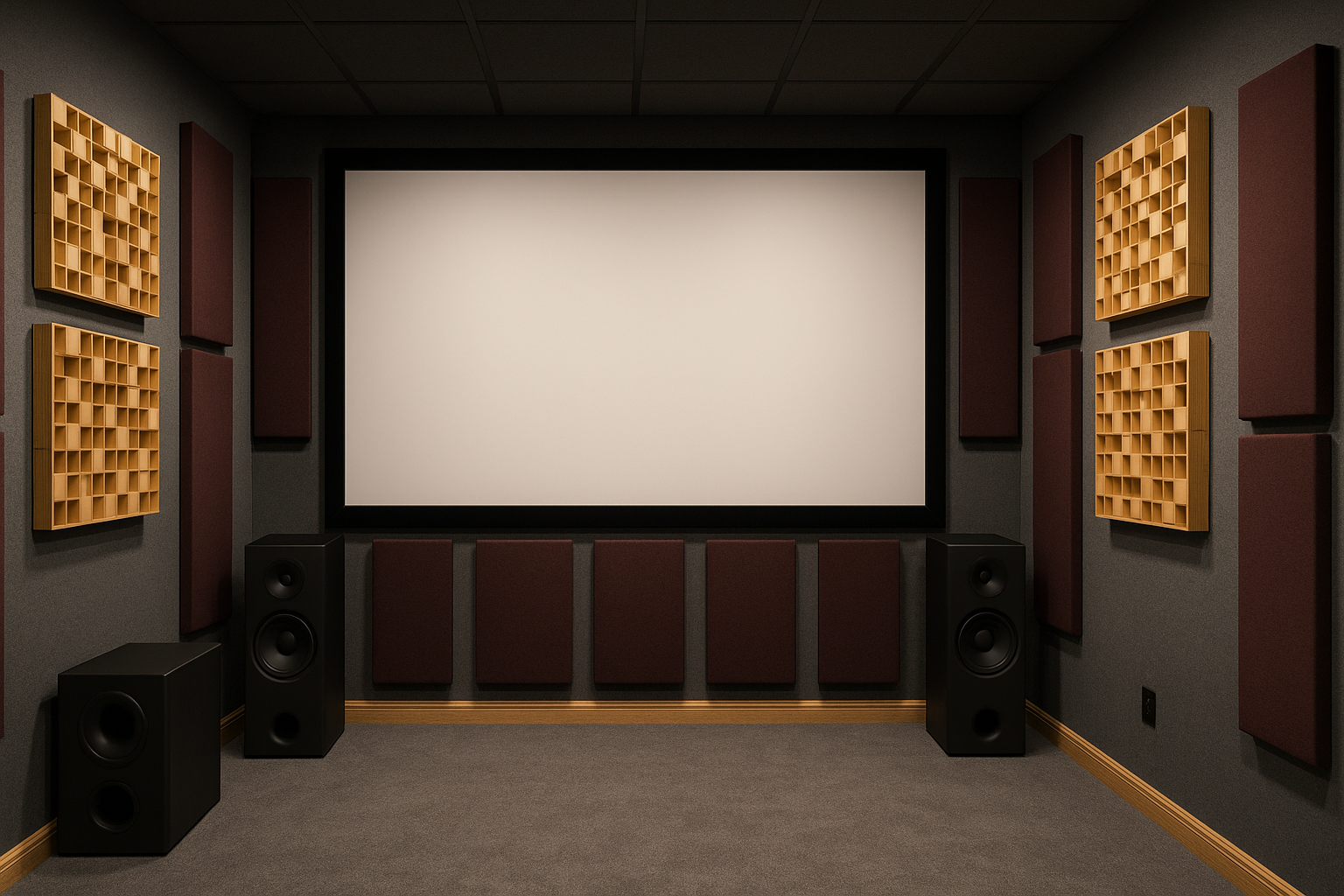
Absorptive panels are the workhorses. They soak up reflections that smear detail, especially in the mids and highs. Think of them as little silence-makers that let the original sound stand out. Materials? Mineral wool, fiberglass, and specialized foams. Pro tip: thicker is generally better, and leaving a small air gap behind each panel deepens its effect.
Diffusion: Keep Energy, Lose the Echo
Diffusers scatter sound so you don’t get harsh flutter or a dead-sounding room. They’re like acoustic kaleidoscopes—energy stays, harshness goes. Wood skyline or QRD diffusers look cool, but they need space to work well.
Bass Control: Tame the Boom
Low frequencies bunch up in corners and along walls. That’s why one seat shakes while another sounds thin. Bass traps—big, dense, corner-friendly absorbers—smooth the lows so the entire row hears the same punch, not chaos. If you’ve ever turned up the bass to feel it and just got mud, this is the fix.
Room Shape, Size, and Surfaces: Read the Space First
Every room in the Wasatch Front behaves differently. A cozy basement with concrete and drywall? Highly reflective without help. An upstairs bonus room with vaulted ceilings? You’ll get longer decay and sometimes flutter. Open-concept spaces are trickier because big openings behave like giant leaks for sound energy.
As a simple target, many dedicated theaters aim for an RT60 (reverberation time) of roughly 0.3–0.4 seconds. That’s short enough for crisp dialogue but not so short that the room feels lifeless. Don’t worry—if that number sounds technical, we’ll translate it into moves you can actually make.
| Surface | What It Does | Treatment Tip |
|---|---|---|
| Concrete/Drywall | Strong reflections; longer decay | Add panels at first reflections; corner bass traps |
| Carpet + Pad | Absorbs highs; leaves mids/lows | Use wall panels; consider ceiling cloud |
| Large Windows | Reflective; bright splash | Heavy curtains; balance with diffusion opposite |
Salt Lake tip: basements stay cool and quiet, but those rigid walls reflect like mirrors. Treat early, and the rest of your system shines.
First Reflections: Quick Wins You Can Hear Tonight
Here’s the thing—controlling the first reflections on your side walls and ceiling usually delivers the biggest, fastest change. Do the mirror trick: sit in your main seat while a friend moves a mirror along the side wall. Wherever you see a speaker in the mirror, that’s a reflection point. Put a panel there. Same idea for the ceiling above the seats with a “cloud” panel. And yes, a thick rug helps if your front third is bare floor.
- Side walls: Two 2×4 ft panels per side, centered at ear height, go a long way.
- Ceiling cloud: A 2–4 inch panel above the main seats reduces “shoutiness.”
- Behind the Screen: If you use an acoustically transparent screen, treat the wall behind it.
Brands like GIK Acoustics, Primacoustic, and Vicoustic make solid panels. You can DIY with safe mineral wool and fabric if you’re handy—just avoid plastic-backed fabrics that reflect.
Bass Traps: The Low-End Secret Sauce
Low frequencies have long wavelengths, so they build up in corners and along boundaries. That’s why you’ll hear that familiar “one-note” boom in some seats. The fix is strangely simple: give the bass somewhere to go. Corner bass traps, soffit traps, or thick panels placed where walls meet walls (and the ceiling) soak up the extra energy.
Want a quick rule? If a panel looks small and thin, it’s probably not doing much for the sub-bass. Bigger is kinder down low. Also, seat and sub placement work in tandem with treatment. Moving the sub a foot or two can smooth a nasty peak. Two subs, placed well, can smooth seat-to-seat differences even more. And no, that’s not cheating—that’s system design.
Tech note for the curious: those stubborn dips around 60–90 Hz are often room modes. Treatment reduces ringing; placement helps avoid the traps altogether. Together, you get tight, even bass that doesn’t bulldoze your mids.
Diffusion: Keep Life in the Room
Some rooms end up too dead once absorption goes up. That’s when diffusion brightens the mood without adding echo. If your theater is mid-sized or larger, diffusers on the rear wall can spread late reflections in a pleasing way. In very small rooms, be cautious—if you sit too close, diffusion can feel odd. In that case, a mix of absorption and shallow diffusion, or even artful slats, can keep things lively and natural.
A Salt Lake City Game Plan: Three Common Rooms, Three Solid Starts
You know what? Let’s make this real. Here are starting points we use for many Salt Lake City home theater layouts. Adjust to taste, but these get you 80 percent of the way.
- 12×16 ft Basement Theater: Two 2×4 ft panels at each sidewall reflection, one 2×4 ft ceiling cloud above the main seats, four corner bass traps (floor-to-ceiling if possible), and one absorber behind the screen or TV. If you’ve got an equipment closet humming nearby, add a door sweep and weatherstrip for a simple isolation bump.
- Open Bonus Room: Focus on the listening area. Use a big rug up front, a ceiling cloud above the seats, and side panels at first reflections only around the seating zone. Corner traps where possible; heavy curtains for any large windows.
- Small Bedroom Theater: Go thinner but smarter. Two sidewall panels, one smaller cloud, a pair of chunky corner traps behind the mains, and modest absorption on the rear wall instead of deep diffusion since you’re sitting closer.
Seasonal side note: during winter when the furnace hums more often, small gaps and rattles show up. Add felt pads to panel frames and check that HVAC vents aren’t whistling. Quiet is part of fidelity.
Measure What Matters: Simple Tools, Big Confidence
Trust your ears—then confirm with data. Free tools like Room EQ Wizard (REW) and a USB mic such as the miniDSP UMIK-1 let you see frequency response, decay (waterfall), and an ETC chart for reflections. If that sounds a bit nerdy, it is—but it’s also wildly helpful. You’ll spot that 70 Hz ring, the pesky early ceiling bounce, or a hole where a panel should live.
Room correction systems like Audyssey (Denon/Marantz), Dirac Live, Anthem ARC, and Yamaha YPAO can polish the response. They’re great teammates. Still, EQ can’t “absorb” a reflection or fix ringing. Do the physical fixes first, then let the software fine-tune. That order keeps your system natural and powerful.
Style Matters: Make It Look Like You Meant It
Functional doesn’t have to mean bland. Panel fabrics come in rich colors and patterns. Many vendors print custom graphics, so your traps can feature family photos at Brighton or Snowbird, vintage movie art, or a Utah Jazz nod on the back wall. Slat diffusers in walnut or black ash bring warmth and texture. We also like wrapped, beveled panel frames for a softer, theater-like profile. When everything looks planned, it feels better—and you’ll actually want to spend more evenings in there.
Budget Talk: Smart Spends That Pay Off
Think of treatment like seasoning a good meal. You don’t need to redo the kitchen to make dinner taste better. For many rooms, a starter package of side panels, a ceiling cloud, and four corner traps beats a more expensive speaker upgrade you can’t fully enjoy anyway. If you’re stretching, treat first reflections and add two corner traps now, then build out the rest over time. Small steps; big audible gains.
Why AZP Home Theaters & Automation?
We design and install acoustic panels, bass traps, and diffusers that fit your room and your style. We’re local—so we know the quirks of basements along the Wasatch Front, the charm of older homes in Sugar House, and the big, bright spaces popping up in Daybreak. We also integrate treatment with your gear: projectors, screens, AVR calibration, even Lighting and control. Clean cuts, safe materials, tidy cable paths—the little things you notice every day.
And if you’re building or remodeling, we can coordinate with your contractor to plan wall cavities, quiet ventilation, and ergonomic seating before drywall goes up. That way your theater sounds right, looks finished, and feels seamless.
Ready To Hear The Difference?
Let’s turn your room into a place where you forget about tweaking and just enjoy the movie, the game, or that late-night concert film. Call AZP Home Theaters & Automation at 385-475-3549, or Request a Free Quote. We’ll bring clear dialogue, tight bass, and a space that finally sounds as good as it looks—right here in Salt Lake City.