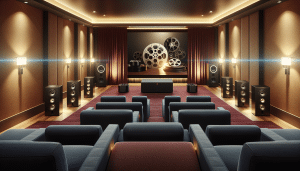
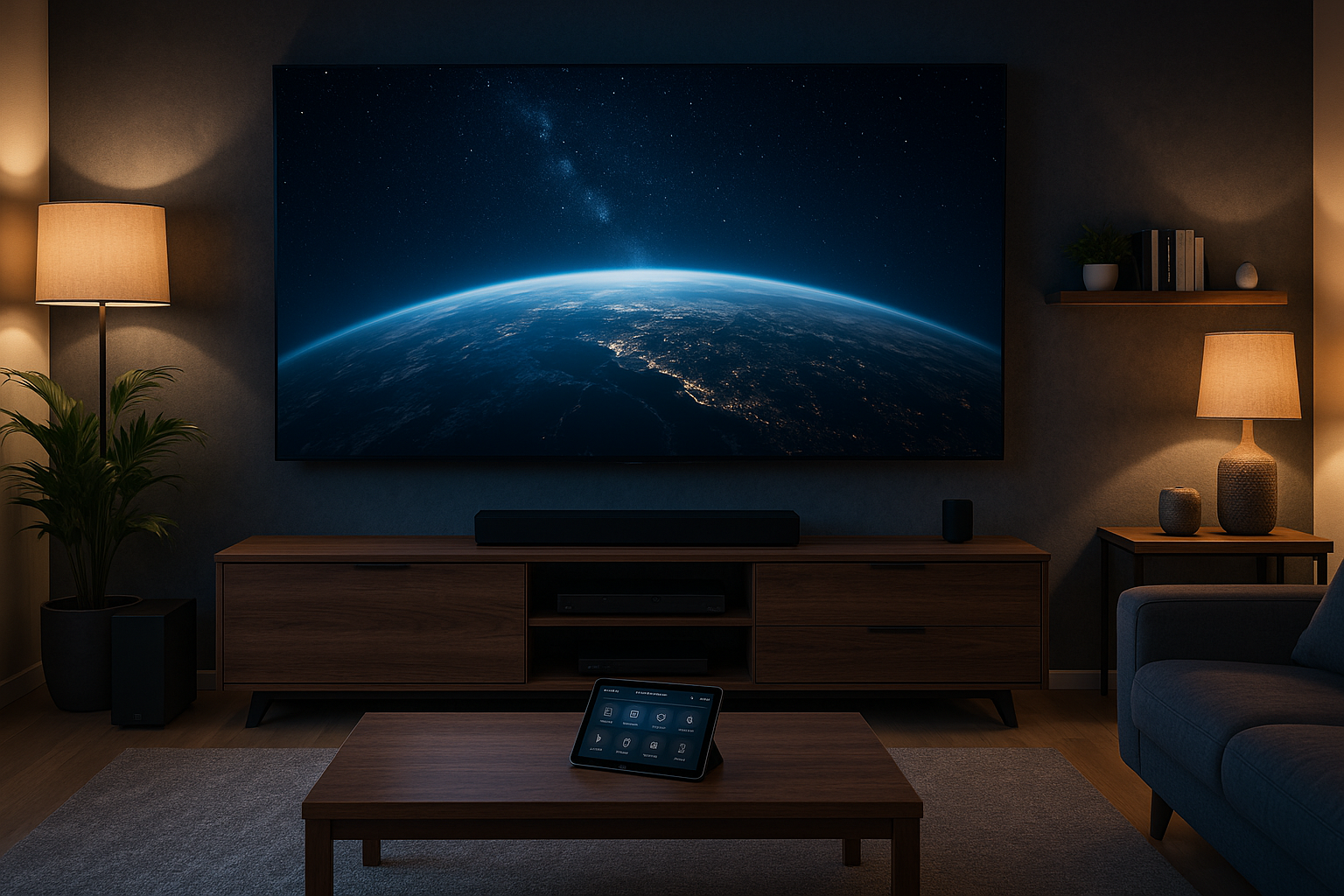
Picture this: snow settling on the Wasatch, a pot of cocoa on the stove, and your living room quietly transforming into a cinema with one tap. That’s not wishful thinking. That’s smart home theater integration—thoughtful tech that fades into the background so entertainment can take center stage. At AZP Home Theaters & Automation, we design systems that feel natural, especially for Salt Lake City homes where comfort, family, and yes, game night, all matter.
So… what is “smart home theater integration,” really?
Let me explain. A smart theater isn’t just a big Screen and some speakers. It’s a unified system that brings your TV or Projector, audio, Lighting, shades, network, and even HVAC under one simple control. One remote. One app. One voice command. No juggling five remotes or awkward input switches.
Under the hood, platforms like Control4 (founded right here in Utah), Savant, and URC orchestrate everything. They connect your streaming devices—Apple TV 4K, Roku Ultra, or Nvidia Shield—to Dolby Atmos sound, manage your motorized shades, and set lights to a cozy level without blinding glare. The goal? Effortless, repeatable magic. Press “Movie Night,” and the room gets it: lights down, shades closed, volume set, inputs ready, and that familiar studio bumper playing through rich, room-filling audio.
Honestly, it’s the kind of convenience you don’t realize you want until you live with it for a week.
Why it matters here in Salt Lake City
Salt Lake homes aren’t one-size-fits-all. We see bright, sunlit living rooms with high windows; quiet basement theaters; and great rooms that double as family hubs. Integration matters because it adapts. In winter, the low sun can throw nasty glare on the screen. With smart shades and daylight sensors, the system handles it. In summer, cooling can be part of the scene so the room stays comfy through a doubleheader or a long binge.
And with Google Fiber and robust UTOPIA connections in many neighborhoods, streaming quality here is fantastic. A well-tuned network ensures that 4K HDR looks crisp and game streams stay smooth—even when the kids are on FaceTime and someone’s uploading photos from the slopes.
You know what? It’s not just about “fancy.” It’s about making the room work for real life in the Wasatch Front.
The core pieces, made simple
Every system is unique, but the building blocks are familiar. Here’s a quick cheat sheet we use when planning:
| Component | What it does | Future-ready tip |
|---|---|---|
| Display (TV or projector) | Delivers the picture; 4K HDR is standard, 8K is niche | Choose HDMI 2.1 inputs for 120 Hz and VRR if you game |
| Audio (AVR or separates + speakers) | Creates space, detail, and bass you can feel | Plan for Dolby Atmos ceiling or on-wall height speakers |
| Control (Control4/Savant/URC) | Runs scenes, ties lighting, shades, and streaming together | Use hard-wired networking for rock-solid reliability |
Small note: wires are boring. Yet they’re the star behind the scenes. More on that in a moment.
Scenes that feel like magic (and keep peace at home)
Scenes are where integration shines. A few we install a lot:
- Movie Night: TV to the right input, receiver at reference volume, lights to 20 percent, motorized shades down, phone set to Do Not Disturb. It just… flows.
- Kids Mode: Volume limited, voice prompts enabled, streaming apps pinned to the top row, bright pathway lighting to the kitchen.
- Jazz Game: Fast-switch to live TV, team-color accent lighting (yes, we do that), and a subtle bass cap so the downstairs baby can sleep.
- Late Night: Dialogue boost on, bass trimmed, and warm-white lighting so eyes stay relaxed.
We’ll often tie in climate. Utah’s air runs dry; when you run the theater for hours, we can nudge the humidifier and HVAC fan so the room doesn’t feel stuffy by the third quarter.
Streaming, gaming, and live sports without the “why is it buffering?” moment
Here’s the thing: picture and sound don’t mean much if the stream stutters. We build stable networks with wired backbones, Wi‑Fi 6E or Wi‑Fi 7 access points, and QoS rules so game day gets priority. Apple TV 4K handles most families’ needs, but we also love Roku Ultra for its clean interface and Nvidia Shield for enthusiasts. Gamers? We set up 4K at 120 Hz, VRR, and eARC paths that don’t lose audio sync.
And because SLC loves a good watch party, we’ll add a “Sports Bar” preset: multi-view, a second screen at the bar, and outdoor audio on delay so conversations don’t overlap the play-by-play. It’s oddly specific. It’s also wildly handy.
Acoustics: the part you hear and the part you don’t
Great theaters aren’t loud; they’re clear. We use Acoustic treatment to tame reflections, focus dialogue, and smooth bass, especially in basements where concrete loves to cause boomy spots. Wall panels can be printed with family photos or Utah landscapes, which keeps aesthetics happy.
We’ll also talk about sound isolation. Simple upgrades—door seals, better back boxes for in-walls, decoupled drywall—keep explosions in the room and out of the nursery. Your neighbors will thank you. Your future self will, too.
Wiring vs. wireless: yes and yes
Wireless is convenient, but wires win for consistency. The best systems use both.
- Prewire smart: Run CAT6A to TVs and control points, 14/2 or 12/2 to speakers, and coax or balanced lines to subwoofers. Add two-inch conduit to the projector or TV wall for painless upgrades.
- Rack it right: Centralize sources and networking in a ventilated rack. It’s cleaner and far easier to service.
- Plan fiber: A short fiber run to the media area keeps you ready for higher bandwidth formats.
We still embrace Wi‑Fi for phones and tablets, of course. But whenever we can hard-wire the heavy lifters, we do. It’s the difference between “pretty good” and “it never hiccups.”
Smart lighting and shades: comfort you feel, energy you keep
Utah’s light is gorgeous, and sometimes intense. Motorized shades cut glare fast; paired with Lutron or Control4 lighting, your room shifts from bright afternoon to cinema mood in seconds. We often use tunable white lighting so evenings feel warm and relaxed while daytime stays crisp.
Pro tip: blackout shades plus a light-blocking side channel can make a living room act like a theater—even at noon. It’s a game-changer.
Control that makes sense for everyone
Technology should feel kind. Voice works for some tasks, but not all. That’s why we like a mix:
- Handheld remote: A tactile remote like the Control4 Neeo or URC MX‑990 is fast, familiar, and reliable.
- Wall keypad: One button for Movie Night. One for All Off. Guests will thank you.
- App control: Granular tweaks, scenes, and room monitoring from the couch—or the airport.
No guessing which input you need. No hunting for the volume. The system follows your routine, not the other way around.
Safety and security tie-ins you’ll actually use
It’s not flashy, but it’s comforting. If the smoke alarm triggers, lights rise and your movie pauses so you can hear the alert. When someone rings the doorbell, a chime can play softly through the theater speakers. We can pop a camera feed on-screen, too, so you don’t miss a package during the fourth quarter.
Late-night returns home? Geo-fencing can bring pathway lights to 30 percent and wake the system without startling the household. Small touches make a big difference.
What should I budget? And can I phase it?
We tailor systems to homes, not the other way around. That said, rough ranges help:
- Starter integrated room: Quality 4K display, 5.1 audio, smart lighting scene, and unified control. Often begins in the mid‑$8k to $15k range, depending on room size and furniture.
- Performance theater: 4K projector or premium OLED, Dolby Atmos with calibrated subwoofers, acoustic treatment, motorized shades, and robust control. Many land between $20k and $45k.
- Flagship experience: Dedicated build, isolation, tiered seating, custom panels, fiber backbone. Pricing is bespoke.
Phasing works great. Start with wiring, the network, and a solid AVR plus speakers. Add shades and lighting next. Then upgrade the display or move to separates. We’ll design a roadmap so every step improves the whole without rework.
Why AZP Home Theaters & Automation
We’re local. We know how the afternoon sun angles into a Sugar House living room, how basements in Millcreek can boom without the right bass strategy, and how a bustling kitchen near the great room needs intuitive controls. Our team handles design, installation, calibration, and training, then sticks around for support. Calibration isn’t a luxury for us—it’s the finish line. We use measurement mics, room correction, and careful tuning so your system sounds balanced at real-world listening levels.
You’ll get a clean rack, labeled cables, and scenes that won’t confuse your guests. And yes, we’ll add a big “All Off” button—because sometimes the simplest button is the one you use every day.
Ready to hear it for yourself?
If you’re picturing your own space coming to life, we’d love to help. Call AZP Home Theaters & Automation at 385-475-3549 and tell us what you have in mind. Or reach out and Request a Free Quote. We’ll design something that looks sharp, sounds incredible, and feels easy for the whole family. One room or the whole house—we’ll make it sing.